Monday, December 18, 2017

3 Industry Impacts of SpaceX- Rocking the Rocket Industry


SpaceX has disrupted the rocket launch industry and we all stand to benefit, but will Elon Musk take us to Mars or 'burn out his fuse alone' in the words of Elton John.
Summary:
Elon Musk's SpaceX has changed the rocket launch industry by introducing free market ideas to an industry previously dominated by Government and entrenched contractors.
SpaceX's disruptive innovation has brought down the cost and improved efficiency of rocket launches undercutting other major industry players like Boeing and Lockheed's ULA and Orbital ATK.
The Rocket launch industry is responding and Jeff Bezos's Blue Origin likely presents the most lean sustainable option besides SpaceX at current valuation
Jeff Bezos and Blue Origin have responded and may present an even leaner yet more sustainable model than SpaceX


1 Applying the Free Market to the Space Race (intro and background)
Rather than going to another state to see an eclipse, in 20 years you might be checking it out from the moon. Unfortunately since the time of the Space Race between, the whole space enterprise has been only affordable to world powers. Since the time of the USSR, interest in going to space only declined as did the amount of capital and thought put into it until in recent decades, Space, the final frontier, re-emerged as the ultimate prize. But this time instead of countries, the competitors are tech billionaires. So as today’s moguls fight for top positions in technology, rockets have also become a source of competition to the titans of industry but we all stands to profit.
The two leading players you've probably heard of Elon Musk of Tesla, backing SpaceX and Jeff Bezos Amazon founder, backing Blue Origin. They're are both interested in sending you to the moon. In addition to Musk and Bezos there is now an ecosystem of startups forming around the increasing interest and demand for space capabilities. Recently Paul Allen of Microsoft has showed interest in launching rockets and Virgin Galactic continues promising customers a zero G experience. Along with an increasing demand for satellites, SpaceX's influence has already opened up a new market that other startups are pursuing. As tech crunch puts it, “SpaceX and Blue Origin are nearly engaged in a new space race albeit one without dire consequences. The two American companies are racing towards similar goals of sustainable space flight through the reuse of rockets that can be landed... Now both companies are reportedly aiming for the moon. This isn’t a zero-sum game; humanity wins if both companies win.”
Disrupting the Rocket Launch Industry
SpaceX’s pioneering efforts has been disruptive innovation to a long dormant industry. As Clayton Christensen originally described disruptive innovation, its “a process by which a product or service takes root initially in simple applications at the bottom of a market and then relentlessly moves up market, displacing established competitors.” Following this process SpaceX is displacing large entrenched government contractors like United Launch Alliance and its owners, Boeing and Lockheed as well as Orbital ATK. SpaceX's launch attempts have been more lean, building with discarded launch equipment. They have been better able to harness the creative, cost sensitive free market to push the rocket development, making them more efficient and flexible than any prior attempts. This has opened up new approaches to the process like landing reusable rockets, reusable space planes, sub-orbital flights, motor-like rockets and electric propulsion.

Other major industry players tend to follow government contract mentality and are also mainly involved in weapons systems, like Orbital ATK formed from the merger of Orbital Sciences Corp. and the Aerospace and Defense groups of Alliant Techsystems Inc. (ATK) and United Launch Alliance (ULA) forming as a joint venture of Lockheed and Boeing. SpaceX is uniquely focused on rockets for transportation, "doing it all themselves, where Orbital tends to either contract for a subsystem or acquire an existing aerospace company." SpaceX builds their own liquid boosters with their own engines while the big aerospace companies buy Russian engines getting them into political trouble. Orbital ATK and ULA are consequently getting less lucrative launch contracts and have been forced to cut costs and produce better rockets capable of competing with SpaceX.
2 Igniting competition with Jeff Bezos
Although they might be the first billionaires vying for space, I find insightful to remember that Elon Musk and Jeff Bezos are only picking up the North-South rivalry started by Steve Jobs and Bill Gates pushing the bounds of technology.
It follows that Bezos like Gates tends to be less creative more business-oriented, methodical and plodding in his progress not making dramatic leaps into the future. He builds more slowly, progressively unlike their Southern rivals, step by step dutifully taking advantage of emerging technology. Bezos, like Gates, tends to apply sound management rather than pursue technology for its own sake. Financially, Bezos is more conservative, using his resources to build his financial base of Amazon. Shortly after recently becoming 2nd richest person in the world he promptly sold off $1 Billion worth of shares which is a much smaller portion of his wealth than Elon Musk has staked on SpaceX and thus will be able to support Blue Origin on the side long into the future.
Risks
To deepen the comparison, both Gates and Bezos have more orderly personal lives having remained with the same women compared to the more dramatic personal lives of Jobs and Musk. Although no one could've predicted Job's untimely death, Musk's profligate stream of love interests and other enterprises does not bode well for continued focus on SpaceX. Musk, like Jobs is a more impassioned visionary. They are both driven by their dreams occasionally to extremes and taking more risky, creative and expensive leaps into the future. They both combine exciting sexy ideas into highly functional products pushing the outer boundaries of what is possible making things functional yet beautiful.
Musk has committed more of his wealth, time and resources, to the future space and space transportation. This has resulted in tremendous breakthroughs like the vertical landing but also more catastrophic failures like the Falcon 9 exploding near takeoff. Musk is the more creative genius pushing towards the lofty prospect of a brighter future for humanity. In pursuing so determinedly his dream Musk has centered himself at the heart of pioneering the disruptive technology that Bezos and other space companies are either forced to compete with or benefit from.

Conclusion
*For a full explanation of how I would invest see the rest of the article
My takeaway is that although Musk and SpaceX are making the most breathtaking breakthroughs, their lasting impacts will end up being the legacy of disruptive ideas left behind. Betting on which company will end up being more profitable and sustainable, I would expect more likely to be riding a Blue Origin brand rocket into the future rather than one made by SpaceX.*  The current general market attitude towards technology and space seem to harken back the the optimistic bravado seen during roaring 20’s of last century. When in the US thought all our lives would be forever improved because of technology. Although I watch in awe at what is being achieved, when the market turns less optimistic I would hope that companies like SpaceX and Blue Origin will still be around to pick put together the pieces as they did with the leftovers from the Space race of last century.



*For a full explanation of how I would invest see the rest of the article wrote for Seeking Alpha.

Major prize surprisingly goes to blue origin over space x.
https://www.fool.com/investing/2016/07/04/eat-your-heart-out-spacex-blue-origin-takes-the-pr.aspx

http://www.dailymail.co.uk/sciencetech/article-3808605/Billionaire-space-battle-takes-Twitter-Jeff-Bezos-takes-aim-Elon-Musk-tweeting-images-model-megarocket-just-hours-SpaceX-founder-showed-Mars-rocket-engine.html


Monday, August 14, 2017

The 7 Habits of Highly Effective Teachers

From The First Days of School, the so-called Bible of teaching. This is a fundamental reference for almost any teacher also good for anyone with kids to be familiar with. Reading it, I really appreciated that it’s encouraging yet real and applicable yet motivating. These are my top 7 takeaways from the book:

1. Preparation. Preparation, Preparation. Being a good (or effective) teacher is more about classroom prep; planning clear underlying procedures than it is about being good at explaining subject matter. If you fail to prepare you prepare to fail. Leadership requires planning. Teachers who don’t think through class procedures at the beginning of the year will spend the rest of the year chasing students. The first few days should be spent on rehearsing this ‘how’ of class functioning before getting into materials. See Chapters 11-17.


Assignments should be easily understood by students and parents
2 Beg, Borrow and Steal! Teachers’ most valuable resource are successful fellow teachers, and the best resource for students are successful fellow students. Studies show that the main distinguishing factor in successful schools is whether teachers actively collaborate and work together. See Chapters. 3,4 and 24.


3 Teacher Attitude and reputation will affect their class, no matter how they might try and hide it. “Right or wrong, accurate or not, your reputation will precede you.”  Teachers must genuinely believe all students can succeed because their attitude will consciously or unconsciously affect how they treat students. How teachers dress and act in their class positive or negative will be talked about by students, parents and administration and decisions will be based on that reputation. Students will reflect a teachers’ attitude. Section B Positive Expectations


4 Rules have consequences and rewards. As opposed to procedures, in a classroom there should only be 3-5  clear rules with clear consistent consequences agreed upon by teacher, parents and students. Choices and taking responsibility for the results of those choices is the most important theme in this book. Teachers should respond to questions of misbehavior reminding students they CHOSE their actions and the consequences.  Students should be held accountable for behavior and teachers should be held accountable for their classes. When teachers choose not to prepare clear routines or plan lessons Teachers are choosing misbehavior.
Section C Classroom Management


5 Student success occurs when students and teachers are moving together towards an clear objective or goal. Assignments and tests are designed mainly to benefit student learning not for parents, teachers or the state. Tests and assignments should be short, written in clear language and be easily understood by students and parents and have a clear purpose. The number one predictor of students success is clear goals (objectives); students must know clearly what is expected of them. Attitude and motivation is a better predictor of student success than any natural talent.  Section D Lesson Mastery
Teacher collaboration determines school success.
6 Teacher limitations. Curriculum should not be made up by teachers. Schools agree on curriculum and states agree on standards. Teachers can get creative in conveying those materials but the content ultimately is agreed on by the collective group. When a school culture and a teacher conflict the culture of the school is most likely to remain unchanged. Chpt. 21 Section D


7 Continue to Grow Invest in yourself and you will move ahead. Teachers who grow their knowledge will also grow student knowledge.  Stay connected with workshops and joining professional organizations. See Section E The Professional


Harry and Rosemary Wong BYU Alums
My Own Commentary below-


I couldn't help but notice the similarities between this book and the 7 Habits of Highly Effective People and in fact, closer I looked the more I realized book might as well be called the 7 Habits of Highly Effective Teachers. I really liked both books, and superficially like Covey, Wong constantly uses the word effective comparing effective and ineffective teachers and also uses many of Covey’s. Their techniques like telling positive stories of change to motivate and inspire teachers also showed. Undoubtedly the Wongs’ post graduate work at BYU under Stephen Covey’s influence greatly affected their thinking and they might have even met or had a class from Covey as he taught at BYU for a number of years.

Much of the underlying philosophy in their work comes back to similar ideas to Covey’s principles of preparation, personal choice and accountability. What I found telling of their deeper values was that Wong chooses to use the story of Rosa Parks while Covey chooses the story of a Holocaust survivor as the ultimate extreme demonstration of choice when circumstances are stacked against you.


My main criticism of Wong’s book might be similar to what I would say about Covey, they both imply that once you master these principles and apply them your class will be much less stressful and smooth sailing. I felt they paint an overly rosy picture. I would argue that for the most part the principles explained are correct and when applied they will produce good results but they will not mean a significantly easier life, the direction is correct so the work at least will produce the desired results which at its best rewards increased effort with better behavior.  


Another point I would make in both works is that an excessive amount of responsibility is placed on the individual. Although this is useful in helping to motivate the teacher take control the many factors they can control, there are still some situations that are beyond the reach of a teacher that Wong doesn't really recognize. I like that he gives examples of a teacher who works in alternative schooling and still is able to adapt the principles to their situation and although they don’t have a complete success there is still some improvement. I would like to hear more details on that story and how the ideas can be applied in more difficult situation like special ed or ESL situations. This also points to the limitations of anecdotal story evidence, that potentially crucial details are left out.

Still overall the book does have some very important ideas for teaching and applies principles of success to teaching in a better way than anyone seems to have.


Wong Biographies:
http://www.uah.edu/news/campus/internationally-renowned-educator-harry-wong-to-lead-uah-workshop-for-k-12-teachers

Friday, July 14, 2017

How to Have a Successful Career in Medicine without Debt ( What I wish I had known)

If you’re early in your education and considering medicine thinking maybe I want to be a Doctor, before you start out out on that 8+ more years of sitting in a classroom, hundreds of thousands of dollars of debt, consider some happier options in the medical field. A Physician's Assistant (PA) and Nurse Practitioner with a Master’s in Nursing (MSN) all make over $100k/year saving lives working with doctors and many even end up coming out close to the same as doctors! These are less stressful, higher job satisfaction, less debt and more flexible options to being a doctor. In these professionals you are also able to work along the way and avoid years of debt and they also don’t require years of Organic Chemistry or other more obscure science classes which you will rarely if ever use.
First off the Physician’s Assistant or PA ( not Pennsylvania)  are growing in demand twice as fast as medical doctors meaning you're way more likely to have good job offers when you are done. Like doctors, Physician assistants can perform physical exams, diagnose illness and develop treatment strategies, order and interpret lab tests, counsel patients, perform various medical procedures, assist in surgical operations, and in most states write prescriptions.
You can immediately get valuable hands on experience helping people that will help pay for your classes and keep you out of debt. Many of the programs actually require hours of paid experience and your application only gets better the more hours you put in.  Working as an EMT or paramedic, Combat medic, Registered Nurse (RN), licensed practical nurse, EEG or EKG (heart) technician, Emergency room technician, Physical therapy aide, CNA ( nursing assistant, sometimes called a patient care assistant), Medical Assistant, Respiratory therapist, Dietician, Phlebotomist or even doing International healthcare based mission trips, Hospice and many others can all count as patient care hours that help your application to become a PA. (Just check the school you’re interested in applying to.)  Rather than being stuck in a classroom paying money, you can be making money getting valuable experience that will help you in your future profession. You also have more flexible hours!

Although traditionally a female profession, nursing is also an amazing place to start out in the medical field to learn as you go no matter who you are. There is still a demand growing much faster for nurses than doctors and you can can find a job practically wherever you live. The easiest and probably least expensive way to start start nursing is at a nearby community college many have an associates RN program that takes 2 years to complete. There are also a lot of private more expensive programs as well, although if the program near you is impacted consider looking a few miles more rural and you can likely find a less full program. If you do not want to go straight into 2 years you can also start out even lower as a CNA, LPN (licensed practical nurse) or LVN (licensed vocational nurse) getting valuable patient care hours and getting paid. And if you have a less job friendly degree in something like psychology there is still hope! There are a lot of entry level programs and you can still work towards a bachelors degree in nursing while taking the pre-reqs.
Probably the best part about nursing other than the high pay, great benefits and established profession (which means great hours, benefits many other perks) is that if you do have any desire to move up the medical ladder and have the power, prestige and pride of a doctor, there are tons of programs designed to help nurses get their bachelors, then masters and even PhD in nursing or nursing related fields. The room for advancement is wide open and well paved. You can easily be making a decent amount of money as a nurse and take classes at night or online or just work a few shifts less and get ahead in the industry while your med school peers are still racking up more and more debt with little actual experience to show for it. Many of the prerequisites for these programs can even be done online while still working.
Fight the male nurse stereotype!
So why would anyone still want to be a doctor? Those who do need the independence, control or recognition that come from being in charge. This comes with responsibility though and many times where nurses and PA's make mistakes it is the doctor who is held accountable. Although there may be a few select individuals where it still makes sense to pursue MD the vast majority of younger students that I come into contact with would have a much happier life and are more satisfied with the career of a PA or Nurse. Likewise, many of the nurses and PA's I meet are overall are much happier, and have a much better work life balance than the Med School friends I know. This shows in studies which show PA ranked as 3rd best job and MD ranked as 17 and doctors are more likely than the general working population to show signs of burnout and to be dissatisfied with their work life balance. You want to read more about it in these forums. Although many young students think they're the smartest most driven and need to prove it by going med school with time and experience for the majority of students the less prestigious more grounded approach will actually lead to more happiness. In the end its a choice each student has to make for themselves but before committing so much debt time and energy I think its at least considering the less extreme options.
 Full list of PA schools with tuition. https://www.thepalife.com/pa-school-tuition-2017/

Tuesday, January 24, 2017

Cell Theory Paper WGU


Bubbles: possible precursor of cells

Human understanding of cells, their purposes and place in Biology has a long incremental historical development. It has taken place over many centuries and been slowly added on to by a number of different researchers and scientists. As contributions were made by so many researchers at different times and through various controversies, it is difficult to track the theory accurately and linearly. Also inseparable from cell theory are the microscopes and related technology like sample preparation which have made cells visible. Most often the advances in cell theory have come from individuals who have concurrently contributed to advancements in microscope technology. Such advances in technology have given those individuals unique perspectives into worlds that were previously unseen by human eyes and from those new unique perspective articulate how the microscopic world works. Although there are a few fundamental principles of cell theory many aspects of the cell have been further elucidated even in the last few decades and some basic tenets of modern cell plasma membrane theory like the sodium potassium pump are still in question. While these current developments are briefly touched on, the main focus of this assignment will be on the fundamental principles of cell theory and its development.
Onion Cells

Those fundamental principles are: 1 All living organisms are composed of one or more cells or cell derivatives. 2 Cell is the unit of life and the common structural unit in all living things. 3 All cells arise from other cells.

Although there were many curious people like Hans and Zacharias Jansen and Galileo who tinkered around with lenses, microscopes and theorized about them they were mostly not much more than a curiosity previous to Robert Hooke. In addition to his work refining the microscope Hooke was one of the first to write a complete study of what he saw in Micrographia published 1665 which also gathered interest in studies with microscopes. Hooke was also the first to recognize cells and name them along with a number of other organisms.

Antoni van Leewenhoek around the same time made contributions to both microscopy and understanding of cells. Although van Leewenhoek had little training in the sciences, only spoke Dutch and  used only a simple microscope as opposed to the compound microscope used by Hooke, with a skillfully ground lens of magnification of 160 Leeuwenhoek was able to view many human cells like red blood cells and a sperm cell for the first time. Even though these human cells were in view, surprisingly it took another 170  years before the generalization was made that all organisms are made up of the same single celled units.

Along with Hooke two major contributions came almost simultaneously and as breakthroughs seem to often come in counter-opposing pairs by Nehemiah Grew (great name for a biologist BTW) and Marcello Malphigi. Both Grew and Malphigi looked primarily at plants as they were easier to fix and view under a microscope, which shows one of the limiting factors of the technology at the time. Grew used similar words to Hooke in his descriptions but thought the space to be bubbles which had formed by a similar process which seemed more logical in plants than it would have in animals. (The bubble explanation is one that is similar in evolution for how cells have been proposed to have originated.) He believed these bubbles to be interconnected while Malphigi called them sacs and thought they were isolated. Although Malphigi’s view was much later was shown to be more accurate the two views served to strengthen the overall acceptance of cells in the scientific community of the time.

Over the course of the next decades researchers in Biology began to show interest in the existence a fundamental smallest unit of life while simultaneously researchers with microscopes were discovering parts of the cell like the nucleus.  An increasing number of microscopists also contributed to observations of cell and nucleuses in other areas for example, Alex Monro saw cells in bones and Caspar Wolff saw them in fat. Robert Brown saw a nucleus in skin cells.  Others like Henri Milne-Edwards, Henri Dutrochet, Francois Raspail, Barthelemy Dumortier, Franz Bauer, Jan Purkinje, Von Baer, Wagner may have grasped parts of the the theory but did not completely demonstrate it. Although some of these researchers personally recorded  and articulated aspects of cell theory around the same time, the full theory was not fully demonstrated or widely accepted until Theodor Schwann did so in 1837. 

Johannes Muller-
Mulled it over, but couldn't get
past vitalism
While Schwann did articulate the cell theory, it would not have occurred without the help of his teacher Johannes Muller who is mentioned next to Schwann and Schleiden as the fathers of cell theory. Schwann was a much more productive and fruitful scientist while working under Muller and was largely inactive as a scientist not long after his major publication. While working with Muller he discovered Pepsin, uncovered the beginnings for germ theory in addition to articulating cell theory in just a few years. Johannes Peter Muller was mentor of a number of influential German physiologists and in his own work brought together different sciences like chemistry and physics in order to give a more full understanding to the function of the organism. Theodor Schwann, only one of his prominent understudies adopted this multi-disciplinary attitude and it was Schwann’s greatest contribution that came from a conversation between Schwann and a botanist Matthias Schleiden. 

Muller did make some lasting contributions of his own to the scientific advancement of physiology in his work Elements of Physiology, but he was limited due to his continued belief in vitalism or the idea the living things have a special component that makes them unique and therefore exempt from the laws that govern from non-living things. A belief that had been perpetuated and held back the achievements in Biology.  

Theodor Schwann-
Muller's protege who brought
Biology out of the darkness
of superstition 
Schwann to his credit broke with vitalism and completely adopted a physico-chemical explanation of life.  In that frame of thinking, in 1837, during a conversation with Mathias Schleiden described on the nuclei of vegetable cells. “Schwann remembered having seen similar structures in the cells of the notochord (as had been shown by Müller) and instantly recognized the importance of connecting the two phenomena.” Recognizing that cells are common to both plants and animals allowed the scientists to generalize them to all living organisms. “The resemblance was confirmed without delay by both observers, and the results first appeared in his famous, “Microscopic Investigations on the Accordance in the Structure and Growth of Plants and Animals” (Berlin, 1839: trans. Sydenham Society, 1837).” In the publication Schwann follows the path of cells through all types of tissue like nails, feathers, enamels showing that although seemingly made from other materials, they all originate with cells. Schleiden also published his portion of cell theory in a monograph entitled Beitrage zuq phytogenesis.

Finally the basic unit of Biology and life had been enunciated which put Biology in touch with modern science and paved the way for Pasteur and the golden age of Biology. It had been nearly 200 years since Hooke had first described cells in cork yet it took until this time for humankind to grasp their significance.  

Although the theory was initially published and had endless implications there were shortcomings in the paper mistaken descriptions of cell replication when which had to be corrected in later years by Rudolf Virchow.

This was for Science Technology and Society course at Western Governors University. The requirements were to choose a scientific theory and write about its history and its formation. 


Requirements:
A.  Analyze a scientific theory of your choice by doing the following:
1.  Summarize the major tenets of your chosen theory 
 Discuss how new ideas refined old ideas in the development of your chosen theory.
b.  Discuss the role technology or mathematics played in the development of your chosen theory.
c.  Discuss how interactions within the scientific community influenced the development of your chosen theory.
d.  Discuss the roles that the following epistemological factors played in the development of your chosen theory:  empirical standards,  logical arguments and skepticism. 
3.  Compare two major scientific contributions made to the development of your chosen theory.
a.  Analyze how the following factors influenced each of the scientific contributions from part A3: prevailing assumptions, personal and societal beliefs, scientific attitudes, talents of individual scientists.

Although I was probably more interested in Antoine Lavoisier's Oxygen theory of combustion I decided to do cell theory because it was more relevant to High School Biology.

References:
1911 Encyclopædia Britannica, Volume 24


Evolution of the Membrane and Bulk Phase Theories
Gilbert N. Ling gilbert.ling.org  Skepticism about bulk transport and membrane theory.

The cell theory, past and present : being the inaugural address delivered November 1, 1889, to the Scottish Microscopical Society

Title:A History of Human Anatomy Persaud, T. V. N., Tubbs, R. Shane, Loukas, Marios p 236 microscopy


Harris, Henry. The Birth of the Cell. New Haven, CT: Yale University Press, 1999.
Magner, Lois N. History of Life Sciences, 2nd ed. New York: Marcel Dekker, 1994.

The cell theory, past and present : being the inaugural address ... Turner, Wm. Sir, (William), 1832-1916.

Notes:Intro with things people use that wouldn't exist without cell theory.  Include cork and other cell resembling pictures.

Robert Hooke used a compound microscope while another major contributor to cell understanding was Antoni van Leeuwenhoek who used a simple microscope with a skillfully ground lens with a magnification power of 160.  

Mathias Schleiden was the first to suggest that all cells have a nucleus although others made similar observations leading up to a full declaration of cell theory. Schleiden primarily worked with plant while the other co-founder of cell theory Theodor Schwann looked mostly at animal cells. They summarized all previous finding in two simple yet infinitely vast reaching premises:

Some might assert that cell theory is well beyond theory at this point since all living things have been found to be composed of cells yet there remains the possibility that we find a new species that doesn’t have cells?

Math was used in calculating the size and number of cells in a given area and technology especially the microscope and slide fixing had to be developed.


Thursday, September 3, 2015

Pro, Pre and Plant biotics - Tasting the Benefits of Microbes

From my presentation for MicroBio.

Summary:
Probiotics AKA beneficial bacteria  have been around forever but their potential has not been fully tapped until relatively recently. After discovering bacteria we initially showed more interest in killing them rather than working together with them. That attitude is slowly changing.

Intro-
While reading in my Microbiology textbook about probiotics I remembered a friend I had at school who consistently had digestive problems. He had said one of the few times he felt healthy was while living as a missionary in Korea. What was it about being in Korea that could have helped his digestion I wondered? He did say the he ate Kimchi every day while there. I wondered, what was so special about Kimchi that could help his digestion? 

Kimchi! http://www.cultureglaze.com
The health benefits of yogurt  are often advertised but after looking into it, I found that any fermented foods like Kimchi can also be an abundant a source of this the beneficial bacteria found in yogurt.  I wondered if there were possibly other foods like Kimchi could also have probiotics? I was delighted to find that while most often associated with yogurt, almost anything fermented can be a good source of probiotics. Foods like Sauerkraut and even Pickles, when fermented, can supply probiotics and help improve digestion.

Historical Context-
Elie Metchnikoff http://vi.sualize.us/
So where did probiotics come from? Milk fermentation and its health benefits are nothing new, since Biblical times we've been fermenting dairy and Roman historian Plinus noted the benefits of fermented dairy products.  Although we knew fermented dairy was good for us, the role of bacteria wasn’t recognized until years after the triumph of Loius Pasteur and germ theory around 1907 when Elie Metchnikoff proposed if replacing  the number of toxic bacteria in the gut with diary bacteria could normalize bowels and prolong life. Metchnikoff, a Russian, himself worked with Pasteur and in addition to being a talented scientist was an optimist about our potential to overcome disease and such a strong believer in the benefits of probiotics he drank sour milk every day until his death at 71.

Along with Metchnikoff, interest in probiotics increased during the pre-world war years. French pediatrician Henry Tissier  observed that children with diarrhea had lower numbers of Y shaped 'bifid' bacteria which were abundant in healthy children.  One of the first studies testing these claims in 1922 used Lactobacillus acidophilus in 20 patients with chronic constipation, diarrhea, and eczema and found improvements in all 3 conditions.  Unfortunately, these observations were sidelined during World War 1 and 2  periods as more emphasis was put war wound treatment with antibiotics and Alexander Fleming's magic bullet penicillin. It has taken decades to get away back away from our obsession with eradicating bacteria and start becoming more interested in living in harmony with them. More recently, interest in probiotics began to ignite once again around as evidenced by the huge growth number of publications on the topic. Since then, characterization of specific cultures and substantiation of health claims have advanced enormously.

Along those lines Pro-biotics were formally defined by UN Food and Ag Org and WHO in 1990 as live microorganisms which when administered in adequate amounts confer a health benefit on the host. This more broad definition recognizes bacteria anywhere in the body. 

Mechanism 
www.probiotic-cn.com/Lactobacillus_Helveticus
So how do they work? Without getting too specific, mainly what it comes down to is competition for space in the lining of your gut. When there are harmless bacteria already growing your gut, they get in the way of other bacteria sticking and growing that could be harmful. The good bacteria also stimulate your immune system and keep it active. 

Some types of bacteria will also last longer over time in the gut, the Bulgaris strain for example not as long lasting compared to other Lactobacillus which can stick around a lot longer.  Different parts of the gut are are also better targets for different strains of bacteria which is why only one strain of probiotics alone may not be sufficient.  Even beyond the digestive tract, bacteria can grow anywhere that presents a dark, moist conditions, so other parts of your body can also benefit from the protective effects of probiotics.

Although there are seemingly endless health claims for probiotics some are very well documented like: 
Decreased diarrhea especially when caused by antibiotics 
Increase lactose tolerance
Stimulation of immunity and decreased likelihood of infection
Reduction of allergic symptoms
Decrease cancer promoting toxins. 

Other claims have some shown evidence  but are not as exhaustively researched like: 
Reducing irritable bowel syndrome
Inhibiting Helicobacteri pylori infection (found in ulcers)
Reducing constipation 
Increase mineral metabolism and bone density stability 
Cancer prevention 
Reduction of cholesterol and triaglycerol plasma concentrations

A Flavorful Future- As understanding of probiotics continues to advance, implications Metchinikoff's initial optimism will continue to open up greater possibilities in both human health and the wellbeing of other organisms.

In 1993 prebiotics were discovered to improve bacterial to growth and activity. These “prebiotics” have been found in foods like Onion, Garlic, Leeks, asparagus, wheat and banana. The research is still fairly new but  the main takeaway is recognizing that some other foods along fermented ones act synergistically with gut flora.  Prebiotics are defined as non-digestible carbohydrates (specifically inulin and its byproducts and trans oligosacharides) that beneficially affect the host by selectively stimulating growth and/or activity of one or a limited number of bacteria in the colon. Similar to dietary fiber except that it selectively benefits certain bacterial species.

www.jollylane.com
Traditional fertilizers and pesticides have a lot of problems with sustainability, they require  huge amounts non-renewable raw chemical ingredients, confront evolving pest resistance and can have undesirable chemical byproducts. Although it may seem like a stretch that bacteria could do the job of plant fertilizers, large companies are already making huge purchases betting on the future of bacteria's role in agriculture.Taxon was acquired by DuPont and companies like Monsanto have made similar large purchases betting on the future of microbes in plant growth and protection. There are a number of other companies offering similar products so whether or not it works the demand alone give some indication that farmers and horticulturalists are seeing results. The possibilities for a mutually beneficial relationship between bacteria and humans indeed do seem limitless and will impact medications, plant health and beyond. Seeing this field continue to advance will be very exciting.

Some of the most diverse varieties of good bacteria come from equally varied food sources  These are a few that have been characterized and the many strains of bacteria they produce: 
Yogurt-Lactobacillus, bifidus, 
Kimchi Leuconostoc, Lactobacillus,  Leuconostoc species Le. mesenteroides, Le. kimchii, Le. citreum, Le. gasicomitatum, and Le. gelidum, the Lactobacillus species Lb. brevis, Lb. curvatus, Lb. plantarum, and Lb. sakei, Lactococcus lactis, Pediococcus pentosaceus, Weissella confusa, Weissella kimchii, and Weissella koreensis 
Saurkraut  A more recent study revealed that four species of lactic acid bacteria, Leuconostoc mesenteroides, Lactobacillus plantarum, Pediococcus pentosaceus, and Lactobacillus brevis, were the primary microorganisms in these fermentations. Sauerkraut fermentations are more diverse than previously reported and include Leuconostoc citreum, Leuconostoc argentinum, Lactobacillus paraplantarum, Lactobacillus coryniformis, and Weissella sp. The newly identified species Leuconostoc fallax was also found. Unexpectedly, only two isolates of P. pentosaceus and 15 isolates of L. brevis were recovered during this study. 
Kombucha - Gluconacetobacter kombuchae is an anaerobic bacteria that is unique to kombucha. It feeds on nitrogen that is found in tea and produces acetic acid and gluconic acid, as well as building the scoby. Zygosaccharomyces kombuchaensis is a yeast strain that is unique to kombucha.    
Kefir 


Friday, July 31, 2015

Tomorrowland Movie Review

Movie Review: Tomorrowland
My Rating: 6 of 10 stars
I really, REALLY wanted to like Tomorrowland, and I did, parts of it at least. Unfortunately those  parts were almost completely overshadowed by the glaring problems with the film that loomed onerously throughout the plot  sapping what little compelling drama it had to offer in the first place.

The good: There are a host of films out that portray dystopian realities of the future and paint a horrific picture of technology and how it will turn on humanity, betray us and wreck our lives. Cinema can't seem to think of the future without coupling it with either a failing and corrupt political system picking up the remnants of a self destruction or as machines and technology itself become the oppressors.  Off the top of my head I can think of Terminator, AI, 2001, The Matrix just to name a few.  There is a void in story telling of a genuinely positive future where technology is viewed in an optimistic light and the future a better place than the past or present. As they portray in the film, if we're constantly pumping in the terrible vision of an unenviable future doesn't it kind of become a self fulfilling prophecy telling us the direction we'll head? So because there's such a great need for that genre to be filled, I wanted to love it. This film held the promise of a vision of a millennial future and was unique in being able to paint it in a positive light. And there were moments where it succeeded, during those brief highlights where the main character was transported to an idealized future. This ended up being is pretty much one of the only scenes you really need to watch from the movie.
    The Bad: Other than that the film reminded me of a B grade power rangers show with silly robots chasing kids around town. In fact the whole back plot about a secret army and the conspiracy of a group of men belonging to a secret future club in the Eiffel tower seemed like a pointless last minute addition and the film would have been better off without without it. Hugh Laurie's wonderful acting and character were drowned out by his tangential monologues and poorly written lines that did more to detract from the character than to help it. 
      The special effects which were necessary to bring a vision of the future to life were used excessively in a futile effort to attract interest where character development and genuine human interests would have been better. Keeping effects subtle and stylish would have been a huge improvement to draw the audience in rather than blatantly showing off what technology could do without leaving anybody wanting it.
     The substance of the plot a bright and ambitious young girl trying to rouse a brilliant man who has become disillusioned with a lost dream of a better world was a good foundation. The characters portrayed by George Clooney and Britt Robertson had the talent and appeal to bring this solid plot to life, but was shot to pieces by a ridiculous subplot of the old man's lingering love affair with a child robot. I can't possibly see who thought George Clooney's unrelenting love for a child robot would make for an emotionally compelling story. More like a weird and slightly twisted justification of why people who are in love love technology should be held with a twinge of skepticism.  His acting felt forced when touching the robot theme as well it should in a context that is both un-relatable and inhuman. And the same could probably be said of the other actors, they did well with what they had but a story lacking human interest made them hard to love. Overall I liked the actors, a lot of the themes and some of the visuals were completely awe inspiring and unlike anything I've ever seen, but this beauty was sadly overshadowed by a poorly layered plot plot held loosely together by garish special effects.

Saturday, May 2, 2015

Pinning An IPO on Pinterest

  • Pinterest has become a major influence in style, social media and the internet
  • Pinterest could potentially profit greatly from its position although it has yet to break out of its core demographics
  • Pinterest has not yet made any official statement about an IPO when it does it could be on of the high water marks of this bull market
One of the first websites ever built was art.net, used to share and sell art and raising the first questions about buying art online. Since that initial idea, art online has evolved into what is now the forefront of setting trends in art and fashion and selling millions of related products. One of the major players, Etsy which sells handmade crafts and antiques just went public and despite not yet achieving profitability reached a 2 Billion dollar valuation. Another much larger art and social media mammoth is still waiting on the sidelines to bring in the most dominant wave of internet start-ups which is completely changing the ecosystem of online traffic.  "Fashion-tech is creating an industry that's more beholden to people's needs than the elitist fashion world of the past. Because a lot of the ways things are done now — fashion-of-the-week shows, buyers, very powerful editors in major fashion capitals — these were the ways that trends were distributed, and they weren't very democratic. But the Internet democratizes everything." Jess Lee CEO of Polyvore

http://tinyurl.com/q5qy9sf
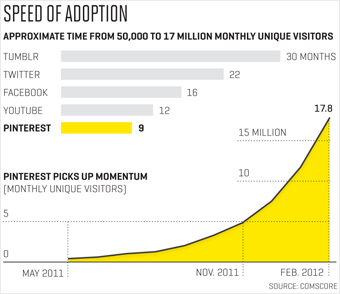
Pinterest with 70 million users is the number one online platform for woman's tastes in the US. Ben Silberman started it after leaving the family trade of medicine for Google and then leaving Google right before the recession to do his own start-up. He struggled to find funding at first but managed to convince former classmate Paul Sciarra to invest and recruited another friend Evan Sharp from Colombia studying architecture to help him design a product of their own. The site grew at a slow pace initially but they stuck it out, resorting to less traditional grass roots marketing like chain letters which laid the social foundations for the later digital growth. Ben jokes that early users came from his mom promoting it to her patients in Iowa. The slow start paid off in late 2011 when in only 9 months the site went from 50,000 users to 15 million by early 2012.
quora.com/Why-is-Pinterests-growth-slowing-in-2014

From those inspiring beginnings the site has continued to grow, but at a far less explosive pace than early on and its main user-ship has largely come from its hometown demographics. At this point about85% of its users are women in the Midwest, making up about 20% of all internet users in the US. The original idea came from Ben's childhood interest in collecting bugs and the underlying appeal of Pinterest still comes from users satisfaction in collecting or pinning things they uniquely love in a way that suits their own artistic vision. As their blog says "we want to inspire you to go offline and do things that you love." Pins are collected on boards related to that customized theme and tap into people's creative outlets and as Steve Jobs recognized when you can do that, possibilities are limitless.

Challenges and Opportunities: The biggest challenge for Pinterest as well as Facebook or any other website has always been to seamlessly turn advertisements into actual purchases. In the case of Pinterest, for users to purchase products related to what they're pinning.  Much like the difference between low end Walmart and upscale shopping like Nordstrom, on the internet there seems to be a trade-off between attracting a large amount of  low spending users and those who will actually purchase something if it meets what they're looking for. While it may initially appear that its 1.2 billion users give Facebook an upper hand, the quality of traffic may be just as important. Pinterest's  greatest strength is that its user-base is a step up from the general internet mass and using Pinterest in a way directly related to what they purchase. Users willingness to purchase can be shown by a few different indicators, but Average order value (AOV)  for Pinterest is $58.95 or as much as $78 on an average order over $55 from facebook. To put this trade-off in context there are even higher end websites like Polyvore and Wanelo that have much less traffic than Pinterest yet the traffic they do have generates much more actual shopping than the general clientele of Facebook or Pinterest. Polyvore alone produces as much as 20% of all social shopping. Such smaller crowd-sourced fashion websites might not pose any real threat to Pinterest but they do suggest the opportunities Pinterest has yet to completely tap.

(from left) Paul Sciarra, Ben Silbermann and Evan Sharp
Paul Sciarra, Ben Silbermann and Evan Sharp
portal.rism.ac.th/kanruetaiy16/
One step towards doing this, recently, Pinterest has started using promoted pins which allows outside advertisers within guidelines to create their own pins. Joanne Bradford head of partnerships at Pinterest says that better targeting is among the wish-list of items she often hears from clients, along with better conversion-tracking and showing how online exposure led to offline sales.  The challenge is to try and keep ads transparent, tasteful, relevant and in line with what users want to experience. In keeping with those aims, they have also acquired Kosei. a Stanford start-up that created that was able to decipher and map the relationships between different products in a catalog, enabling it to make smarter recommendations to consumers.

Pinterest was initially designed as a platform that appeals to users visually that worked best with a monitor. They have had to re-adapt their platform to take advantage of mobile and incidentally took it a step further with guided search which basically suggests search terms that others find interesting. Guided search has had surprisingly serendipitous outcomes because although Pinterest had dominated its native demographic it has also pigeonholed itself and had difficulties gaining much of a male following. Guided search has helped boost queries by men in addition to boosting overall queries by 30 percent and gained attention by other tech giants as a tentative step towards the internet of things. It also led to one of the most promising partnerships, prompting Apple to team up with Pinterest to allow them to suggest apps that relate to a users style and pinning preferences.

Pinterest.com
Rather than try to expand to different demographics Pinterest has also tried moving horizontally to reach an international audience. Back in February 2013 Pinterest during Series D funding Pinterest listed “international growth” as one of the initiatives that the money would be used for. During that time it also received a $100 million investment from Japanese e-commerce giant Rakuten — another sign of its international ambitions. Pinterest started off its international "localization" strategy in the U.K. by tweaking the site so that it highlights U.K. content to U.K. users and also adding a British English language settings to suite British users. It has since announced it will open offices in Spain, Italy, Netherlands and Sweden. Whether it will be able to completely bridge cultural gaps in such a style sensitive platform and gain the same kind of following and make good on promises still remains an unknown.

Polyvore co-founders Jess Lee and Pasha Sadri
http://venturebeat.com/2012/11/27/polyvore-launch/
Valuation and Risk  In 2013 Pinterest raised $200 million at a valuation of $2.5 billion. and in 2014 the tag had gone up to 3.8 Billion. 5 months later in May 2014 it was valued at $5 billion and then in a funding round in March this year it had more than doubled to a price of $11 billion thanks partly to guided search. While its hard to access reliable financial data, considering that Facebook is valued at $200 Billion multiplying number of user with a slightly higher AOV value that facebook by its total number of users very rough estimate agrees that Pinterest is potentially worth $10 billion at current market valuation. I question whether Facebook and other social media could over-valued with a P/E ratio of 80, but the general attitude seems that their potential future earnings justify the price. As Benjamin Graham wisely points out, “One fairly dependable sign of the approaching end of a bull swing is the fact that new common stocks are offered at prices somewhat higher than the current level for many medium sized companies with a long market history.”  Considering their lack of history the market may be over anxious to place a high value on their future earnings because it is at the center of a particularly popular industry. That being said of the companies in this space Pinterest seems to be one of the more prominent and their growth appears real.

Flash in the pan
Flash in the pan? hedgeconnection.com/blog/?p=2147
Another question that investors might ask is whether these social sites which have come into popularity so quickly and are so subject to user tastes might fade from favor as quickly as the fashions they convey. I suggest this is a major lasting shift and Millenials and those growing up using social media will be as at home using this medium as much or more than a catalog. The fact that other sites like Polyvore etc are doing similar work indicates that Pinterest is the natural and obvious application of technology to already set habits, a logical progression of how things are done rather than a short lived trend. There will undoubtedly be more opportunities as technology progresses so Pinterest's competitive advantage will partly depend on them staying on top of emerging consumer technology like they have done with mobile. Other deeper questions like whether Millennials will prefer buying products online over in-store and what types of items are people okay buying online rather than needing to see it in person continue to be answered individually and collectively. In a downed economy as with TV, during recession there were more internet users because they use the internet for outside idea resources and the wealthy if they have are shopping online now, wouldn't change.

Going Public- In the past Silberman has specifically said they are not eager to go public. Although it's not obvious when, they are preparing, allowing employees to leave when they like without losing their stock options. Since there is no official statement all is still speculation, but they do have over 500 employees and at a 10 Billion valuation they are getting to be a larger private companies which might produce some kind of pressure to do so. If all of their employees are issued shares there will be a need to publish their financial data.  As with their user growth they may lag behind what other social media companies have done for a short while because they are more custom made but as Etsy even the most hand crafted companies will not avoid it for too long and when they do I would expect a lot of buying interest. If interested in buying Pinterest stock, you will probably have to wait until well after 2016 before it actually goes public. 


https://www.youtube.com/watch?v=B8crbW0q-_s Interview with Jess 2012

http://www.logicspot.com/ecommerce/polyvore-social-commerce-done-well/

http://en.wikipedia.org/wiki/Pinterest

http://www.forbes.com/sites/jeffbercovici/2014/10/15/inside-pinterest-the-coming-ad-colossus-that-could-dwarf-twitter-and-facebook/

http://www.investopedia.com/financial-edge/0612/pinterest-the-next-social-media-giant.aspx
http://www.zacks.com/stock/news/160435/is-pinterest-a-top-ipo-candidate-for-2015