- Pinterest has become a major influence in style, social media and the internet
- Pinterest could potentially profit greatly from its position although it has yet to break out of its core demographics
- Pinterest has not yet made any official statement about an IPO when it does it could be on of the high water marks of this bull market
One of the first websites ever built was art.net, used to share and sell art and raising the first questions about buying art online. Since that initial idea, art online has evolved into what is now the forefront of
setting trends in art and fashion and selling millions of related products. One of the major players, Etsy which sells handmade crafts and antiques just
went public and despite not yet achieving profitability reached a 2 Billion dollar
valuation. Another much larger art and social media mammoth is still waiting on the sidelines to bring in the most dominant wave of internet start-ups which is completely changing the ecosystem of online traffic. "Fashion-tech is creating an industry that's more beholden to people's needs than the elitist fashion world of the past. Because a lot of the ways things are done now — fashion-of-the-week shows, buyers, very powerful editors in major fashion capitals — these were the ways that trends were distributed, and they weren't very democratic. But the Internet
democratizes everything."
Jess Lee CEO of Polyvore
 |
| http://tinyurl.com/q5qy9sf |
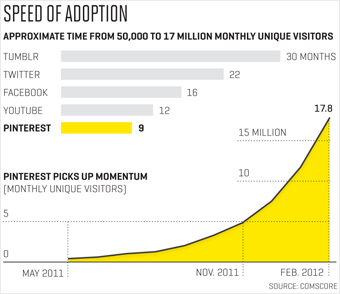
Pinterest with 70 million users is the number one online platform for woman's tastes in the US. Ben Silberman started it after leaving the family trade of medicine for Google and then leaving Google right before the recession to do his own start-up. He struggled to find funding at first but managed to convince former classmate Paul Sciarra to invest and recruited another friend Evan Sharp from Colombia studying architecture to help him design a product of their own. The site grew at a slow pace initially but they stuck it out, resorting to less traditional grass roots marketing like chain letters which laid the social foundations for the later digital growth. Ben jokes that early users came from his mom promoting it to her patients in Iowa. The slow start paid off in late 2011 when in only 9 months the site went from 50,000 users to 15 million by early 2012.
 |
| quora.com/Why-is-Pinterests-growth-slowing-in-2014 |
From those inspiring beginnings the site has continued to grow, but at a far less explosive pace than early on and its main user-ship has largely come from its hometown demographics. At this point about85% of its users are women in the Midwest, making up about 20% of all internet users in the US. The original idea came from Ben's childhood interest in collecting bugs and the underlying appeal of Pinterest still comes from users satisfaction in collecting or pinning things they uniquely love in a way that suits their own artistic vision. As their blog says "we want to inspire you to go offline and do things that you love." Pins are collected on boards related to that customized theme and tap into people's creative outlets and as Steve Jobs recognized when you can do that, possibilities are limitless.
Challenges and Opportunities: The biggest challenge for Pinterest as well as Facebook or any other website has always been to seamlessly turn advertisements into actual purchases. In the case of Pinterest, for users to purchase products related to what they're pinning. Much like the difference between low end Walmart and upscale shopping like Nordstrom, on the internet there seems to be a trade-off between attracting a large amount of low spending users and those who will actually purchase something if it meets what they're looking for. While it may initially appear that its 1.2 billion users give Facebook an upper hand, the quality of traffic may be just as important. Pinterest's greatest strength is that its user-base is a step up from the general internet mass and using Pinterest in a way directly related to what they purchase. Users willingness to purchase can be shown by a few different indicators, but Average order value (AOV) for Pinterest
is $58.95 or as much as $78 on an average order over $55 from facebook.
To put this trade-off in context there are even higher end websites like Polyvore and
Wanelo that have much less traffic than Pinterest yet the traffic they do have generates much more actual shopping than the general clientele of Facebook or Pinterest. Polyvore alone
produces as much as 20% of all social shopping. Such smaller crowd-sourced fashion websites might not pose any real
threat to Pinterest but they do suggest the opportunities Pinterest has yet to completely tap.
 |
Paul Sciarra, Ben Silbermann and Evan Sharp
portal.rism.ac.th/kanruetaiy16/ |
One step towards doing this, recently, Pinterest has
started using promoted pins which allows outside advertisers within guidelines to create their own pins.
Joanne Bradford head of partnerships at Pinterest says that better targeting is among the wish-list of items she often hears from clients, along with better conversion-tracking and showing how online exposure led to offline sales. The challenge is to try and keep ads transparent, tasteful, relevant and in line with what users want to experience. In keeping with those aims, they have also a
cquired Kosei. a Stanford start-up that created that was able to decipher and map the relationships between different products in a catalog, enabling it to make smarter recommendations to consumers.
Pinterest was initially designed as a platform that appeals to users visually that worked best with a monitor. They have had to re-adapt their platform to take advantage of mobile and incidentally took it a step further with guided search which basically suggests search terms that others find interesting.
Guided search has had surprisingly serendipitous outcomes because although Pinterest had dominated its native demographic it has also pigeonholed itself and had difficulties gaining much of a
male following. Guided search has helped boost queries by men in addition to boosting overall queries by 30 percent and gained attention by other tech giants as a tentative step towards the internet of things. It also led to one of the most promising partnerships, prompting Apple to
team up with Pinterest to allow them to suggest apps that relate to a users style and pinning preferences.
 |
| Pinterest.com |
Rather than try to expand to different demographics Pinterest has also tried moving horizontally to reach an
international audience. Back in February 2013 Pinterest during Series D funding Pinterest listed “international growth” as one of the initiatives that the money would be used for. During that time it also received a $100 million investment from Japanese e-commerce giant Rakuten — another sign of its international ambitions. Pinterest
started off its international "localization" strategy in the U.K. by tweaking the site so that it highlights U.K. content to U.K. users and also adding a British English language settings to suite British users. It has since announced it will
open offices in Spain, Italy, Netherlands and Sweden. Whether it will be able to completely bridge
cultural gaps in such a style sensitive platform and gain the same kind of following and make good on promises still remains an unknown.
 |
Polyvore co-founders Jess Lee and Pasha Sadri
http://venturebeat.com/2012/11/27/polyvore-launch/ |
Valuation and Risk In
2013 Pinterest raised $200 million at a valuation of
$2.5 billion. and in 2014 the tag had gone up to 3.8 Billion. 5 months later in May 2014 it was
valued at $5 billion and then in a funding round in March this year it had more than doubled to a price of $11 billion thanks partly to guided search. While its hard to access reliable financial data, considering that Facebook is valued at $200 Billion multiplying number of user with a slightly higher AOV value that facebook by its total number of users very rough estimate agrees that Pinterest is potentially worth $10 billion at current market valuation. I question whether Facebook and other social media could over-valued with a P/E ratio of 80, but the general attitude seems that their potential future earnings justify the price. As Benjamin Graham wisely points out, “One fairly dependable sign of the approaching end of a bull swing is the fact that new common stocks are offered at prices somewhat higher than the current level for many medium sized companies with a long market history.” Considering their lack of history the market may be over anxious to place a high value on their future earnings because it is at the center of a particularly popular industry. That being said of the companies in this space Pinterest seems to be one of the more prominent and their growth appears real.
 |
| Flash in the pan? hedgeconnection.com/blog/?p=2147 |
Another question that investors might ask is whether these social sites which have come into popularity so quickly and are so subject to user tastes might fade from favor as quickly as the fashions they convey. I suggest this is a major lasting shift and Millenials and those growing up using social media will be as at home using this medium as much or more than a catalog. The fact that other sites like Polyvore etc are doing similar work indicates that Pinterest is the natural and obvious application of technology to already set habits, a logical progression of how things are done rather than a short lived trend. There will undoubtedly be more opportunities as technology progresses so Pinterest's competitive advantage will partly depend on them staying on top of emerging consumer technology like they have done with mobile. Other deeper questions like whether Millennials will prefer buying products online over in-store and what types of items are people okay buying online rather than needing to see it in person continue to be answered individually and collectively. In a downed economy as with TV, during recession there were
more internet users because they use the internet for outside idea resources and the wealthy if they have are shopping online now, wouldn't change.
Going Public- In the past Silberman has specifically said they are
not eager to go public. Although it's not obvious when, they are preparing,
allowing employees to leave when they like without losing their stock options. Since there is no official statement all is still speculation, but they do have over 500 employees and at a 10 Billion valuation they are getting to be a larger private companies which might produce some kind of pressure to do so. If all of their employees are issued shares there will be a need to publish their financial data. As with their user growth they may lag behind what other social media companies have done for a short while because they are more custom made but as Etsy even the most hand crafted companies will not avoid it for too long and when they do I would expect a lot of buying interest.
If interested in buying Pinterest stock, you will probably have to wait until well after 2016 before it actually goes public.
https://www.youtube.com/watch?v=B8crbW0q-_s Interview with Jess 2012
http://www.logicspot.com/ecommerce/polyvore-social-commerce-done-well/
http://en.wikipedia.org/wiki/Pinterest
http://www.forbes.com/sites/jeffbercovici/2014/10/15/inside-pinterest-the-coming-ad-colossus-that-could-dwarf-twitter-and-facebook/
http://www.investopedia.com/financial-edge/0612/pinterest-the-next-social-media-giant.aspx
http://www.zacks.com/stock/news/160435/is-pinterest-a-top-ipo-candidate-for-2015