Friday, February 28, 2014

Defending Steve Jobs-4 Balancing Forces in the Man behind the Mac

What do you get when you put the brain of a professor, with an American blue collar work ethic in the heart of Silicon Valley? Steve Jobs was one of those people that you either love or hate, partly because he was "either trying to seduce you or telling you you were crap."[i]  Thankfully I never had to work with the guy, but still when I hear him criticized, as a Bay Area citizen I must opine. First, I would point out that he never actually planned on being a business guy or starting a company. He was initially intrigued by the the idea while working nights at Atari and even then, he only allowed himself to work a normal job after he was assured by his Buddhist guide, Kobun Otogawa, that it was possible to keep in touch with his spiritual side while working. At that point he still had a job and he only ventured out on his own after he felt sure he could make a decent living as an engineer. His actions in the business world may be controversial, but even if he did LSD, he never really liked alcohol and although betrayed his friends and got his girlfriend pregnant, he later settled down and effectively adopted his estranged daughter. Beyond i-pods, i-phones and Pixar, Jobs embodied four other paradigm shifts that have since become the norm.


1.Your business and your cause are one. Jobs always saw his work in technology as more than a livelihood but an opportunity to build a better tool for the human mind. Jobs briefly set up a charitable foundation but became annoyed at having to deal with it. For Jobs greatest way to contribute to social causes was to build amazingly useful devices and that made the world a more efficient place and in the end he channeled most of his ideology into his company. This was at the root of his ability to persuade or motivate for Apple. As he said to John Skulley “Do you want to spend the rest of your life selling sugared water or a chance to change the world?” With Jobs it was  never about promoting his computers, it was about the greater movement. Since then, the popularity of entrepreneurship business as means of attacking social causes has continued to increase.[iii] Businesses now act more like social causes and charitable foundations appear more like businesses. Basic products like shoes (Toms), Unilever and every other food label have to justify their existence through some charitable cause. Indeed it seems you cannot produce a lasting business unless you have a fundamental benefit for the modern world and an equally powerful cause to help the developing one. 


2. The chic geek. Jobs popularized the chic geek and clearly showed that nerdy can be stylish. There were professors and there were rock stars, he was both. Before him computers were large metallic, grey and black. He showed that you can work in a lab with computers and not have to check your sense of style at the door. “Great art stretches the taste, it doesn't follow them.” He would say. He took cues from great Western European architects like Mies van der Rohe and Walter Gropius and God in the details and clean lines and their modern heirs in the likes of Johny Ive. He also revered the beauty of the Kyoto gardens and the underlying Eastern philosophy and designers like I.M. PEI and Issey Miyake and valued their aesthetic. He set the tone for tech company cultures where smart unorthodox thinking is embraced and glorified. In a sense he epitomized Californian Bay Area, a place where the some of the smartest and most brilliant people are drawn to do high level research, but still retains a very distinct attitude and style, a place where Eastern culture meets the Western system.
 Edwin Catmull, Steve Jobs and John Lasseter fortune.com


3. Simplicity still is the ultimate sophistication. “The lesson Jobs learned from his Buddhist days was that material possessions often cluttered life rather than enriched it." In world that becomes increasingly complex, simple solutions become even more valuable. Jobs never had an entourage, personal staff or security detail and he always made his own calls and drove his own car. He lived up to his own ideals and delivered empowering technology that lifts and enables the most common user.   “Any idiot can make something complex; it takes true intelligence to make something simple.”[iv]  The kind of simplicity referred to doesn't mean a simplicity that ignores complex issues, but that harnesses, harmonizes and balances the opposing complexities into lasting solutions as jobs did in his own life. The ability to to sift through large amounts of data and not lose your humanity and common sense in the process is a trait that Jobs possessed and it is an ability that will be even more valuable as we become laden with more and more data.


4. Shared Ideas in a Closed System. “Good artist copy and great artists steal…We have always been shameless about stealing great ideas.”[i] Jobs used good ideas regardless of where they come from or who gets credit for them combining artistic creativity with unabashed hijacking. This attitude is probably also the biggest critique of Jobs in a culture of patents, works cited and copyrights. Steve Jobs disregarded those concerns and just presented the best ideas as his own and incorporated them into his working world. When Jobs first walked into Xerox and was introduced to a graphic user interface he didn’t ask who came up with this or how can we make money on it. He just gushed “this is it!” He later recalled: “It was like a veil being lifted from my eyes. I could see what the future was destined to be.[ii]”  He was far enough ahead and managed to avoid getting bogged down squabbling over where or who they came from. Jobs was quick acting and adaptive partly  because he cared more about making brilliant ideas happen than worrying over who thought of it first.


[i] Bill Gates 
[ii] Steve Jobs by Walter Isaacson p. 98
[ii]  Isaacson p 97
[iii] Michael Porter: Why business can be good at solving social problems http://www.ted.com/talks/michael_porter_why_business_can_be_good_at_solving_social_problems.html
As well as other talks on related topics http://www.ted.com/playlists/139/social_good_inc.html
[iv]Richard Branson

Tuesday, January 7, 2014

On Buffet


What's so Great about Warren Buffet? 
5 Unexpected Traits in the U.S.'s Greatest Businessman

Whether or not you’re interested in money, if you have ever bought chocolate from See’s Candy, seen a GEICO ad, or been to Dairy Queen you should know something about the owner Warren Buffet. You might assume since he’s super wealthy, that he’s a greedy corporate jerk.  In fact, for a business person, he is amazingly honest, open and humble. In many ways he is the exemplary business person and his method has brought him nearly infinite financial rewards. Yet, despite being one of the richest men in the world,* what is most interesting about the guy is not his money. Here are a few ways he might surprise you.

1: Buffet Has Not Always Been Wealthy- Warren grew up during the Great Depression and it left a lasting impression on his psyche. He felt firsthand the gnawing, crippling effect that a downed economy can have on people and a country. Since then he seemed driven to seek out business opportunities. He delivered papers, sold bubble-gum, Coca Cola and even bought pinball machines. One of his most memorable jobs was at his uncle’s grocery store. It was here that his uncle taught Warren the importance of saving and had a lasting impression on him and his future business partner Charlie Munger. At 11, Warren made his first stock purchase and the world has never been the same since.

 2 Business School Was Not Crucial to Buffet’s Success- Buffet has on multiple occasions said: “The business schools reward difficult, complex behavior more than simple behavior, but simple behavior is more effective.”From his youth Warren said he loved “analyzing, buying and selling stocks, but my results were no better than average.  Beginning in 1951 my performance improved. The only ingredient was Ben Graham’s ideas.[1]”  He later reminisced: “I attended Colombia University not because I cared about the degree, but because I wanted to study under Ben Graham. The time I spent in Ben’s classes were a personal high. [2]” After school Graham still refused to let Buffet work for him and worked for his dad’s investment firm where he went door to door trying to sell stocks one of which was GEICO. After marrying, Graham let him work for his firm Graham-Newman Corp where he worked until it closed in 1956 until Buffet was able to form his own partnerships.
Buffet and Graham

3 Buffet Is Not Naturally Frugal- Buffet throughout his early years and much later was extremely, famously frugal. He is legendary for driving a used VW beetle and buying a used Cadillac even though he was able to afford a new one. His children didn’t know what he did for work to the point where his daughter mistakenly told her class their dad was a security guard. He continues to live in the same house that he bought in 1958 for $31,500.  While his frugality might just seem like an odd personality quirk, the real reason he was so frugal is because he really believed he had to be. Even up until 1980, he openly questioned whether his company after all their much blood sweat and tears had done more than kept pace with the value of gold.[3] He knew all too well the business risks involved and he still honestly did not know if he would make it until much later in his career and at which point his frugal habits had become a part of him.


4 Buffet is Not The Most Talented Money Manager Alive - Buffet was anything but a genius when he started out and even now, it’s not his brilliance that makes him unique but his perseverance and unique combination of CEO and money manager.  He started out buying textile factories which were largely economic mistakes and even after experiencing years of lackluster performance he stubbornly stuck to it and as he relates jokingly “in a rare burst of brilliance I went out and bought another textile factory.[4]”  Before he perfected his investment technique he tried and failed investing in aluminum and acknowledges the low returns on his attempt at investing in airlines.  
     Besides Buffet’s mistakes, Warren recognizes that the GEICO money manager Lou Simpson often outperformed his own investments. There are examples of other fund managers like John Neff who have long successful records but usually while was working for others.  What’s different about Buffet is unlike Lou Simpson or John Neff, Buffet is putting his own money in along with his partners’ and has consistently stuck with it longer than anyone. He follows the example of one of his store owners Rose Blumkin who continued to work well past her 90’s and they both had the attitude that you die when you stop working.   
In addition to his long lasting investing career, Buffet acts both as CEO and yet still think like an investor. There might be better investors out there and many more talented CEO’s, it is very rare to find the head of a company who is also great at re-allocating cash the business produces. Buffet’s combination of both CEO and financial advisor is partly why Berkshire Hathway operates with minimal corporate staff and because he continues to reinvest the proceeds at high returns, his company is able to grow at an extremely accelerated pace.  
5 Buffet Doesn't Actually Love Money- Lastly and what is most striking about Buffet is that he can do high level managerial skills yet still relate to people he grew up with.  According to his own family, money hasn’t really changed Buffet on a fundamental level.[5] His definition of success is "being loved by the people you hope love you." When I look around, I often see people who drastically change their habits and feel the need try to improve their lifestyle when that start making a lot less money than Warren Buffet. In a modern world of flaunting wealth I think we need more Buffet-ness. 
      Bufffet completely cemented his greatness in 2006 when he committed to giving 85% of his wealth to the Bill and Melinda Gates foundation. While there have been major philanthropists before Buffet, (he and Bill Gates have been been compared to Dale Carnegie and John Rockafeller) few have done it in such extremes and influenced so many other wealthy individuals in the process. George Washington was said to be greatest man who ever lived because he was able to lead an army and gain their trust yet not be swallowed by that power when he turned it over to congress. Buffet has similarly shown such mastery with the market, being able to command more of it probably that anyone alive and then turn it over to philanthropy.  Buffet demonstrates the great paradox about money that the more you are able to emotionally detach, the better you are at handling large amounts of it. As I take and honest look at myself and others I sometimes wonder if we all could do the same.


*After promising much of his money to the Bill and Melinda Gates Foundation Buffet’s ranking on Fortune’s list has lowered while Gates has shot to the top. If you consider the donation to the foundation still as part of Buffet’s wealth Buffet could definitely be considered the richest man alive. 
[1] Berkshire Hathway Letter to Shareholders 2000
[2] Letters 1995
[3] Letters 1979
[4]Letters 2010
[5] The Tao of Warren Buffet Mary Buffett & David Clark


Monday, December 23, 2013

Images for A Solemn Song

I really like the simplicity of this song and decided it needed some imagery to go along with it. It makes me think of the life cycle of a bird, so simple and innocent yet beautiful.

Saturday, December 14, 2013

Writing Revolution- Best thing since movable type?

   
I'd consider myself book lover (bibliophile.) I don't just mean I love reading, or the information that I get from books, but I've had enough memorable experiences with paper and print that I am emotionally attached to books. I enjoy the experience of reading imagining the ideas and places presented in the text. I also dig bookish people, librarians and the culture that has grown around books and I know I'm not the only one. It's natural for us as individuals and collectively to be sentimental about our paper past. Still, I recognize it is an emotional attachment and if there really is a better way to store and convey information than we probably should and will adopt it. We might develop a relationship with that new medium as well. Around the time of Gutenberg people probably feared the vast implications of that new form. They might have thought that printed letters were so inhuman as compared to the calligraphy and beauty that was in the hand written word. Or authorities considered the lowered the quality of information because it wasn't personally checked by a monk scribe. I think we can all look back though and see that improvement, or invention or innovation or whatever you call it and acknowledge that it has largely helped and continues to benefit humanity. In fact, on the top of my list of things that make me optimistic for the future of humanity I would definitely put the increasing literacy* and availability of literature as one of the top, maybe number 1.
 

Since then, printing technology has continued to improve but not until recently has there been another complete overhaul. First, personal computers re-thought desks and may have helped us at work but they still didn't quite replace the book. (I think its interesting that Steve Jobs who was influential in the death of written material appreciated very much fonts, typeface and feel of letters, its almost as if he, the father of the revolution, wanted to preserve a vestige of a culture he was about to lay waste to, but was I'll post about him later.) Then came the kindle. Now we have these book-like tablets that can hold loads of books and don't waste paper or have to buy a new editions each time there are changes or edits. The pros and cons are many and the debate continues where ever people consider buying a tablet.
In the end, you can debate it all you want, but price tends to be one of the best guides of how practical things are. If I can get the same book more cheaply and quickly on a tablet, eventually the shift will happen, though as yet print has proven resilient. Another salient advantages of a tablet is as a space saver, so where space is at a premium like in a small apartment, in the city or trudging through the desert sand, sweatily lugging around a bunch of books, a tablet should win. The fall out of of the subsequent shift to digital has already been substantial: small or weakly managed newspaper, magazine and book companies have been gone out of business and many jobs lost(1), although some larger well capitalized companies with forward thinking management have successfully transitioned to online and e-books. But the floodgates are now open and I don't think the digital wave will relent.

    We can guess that the next in line are slower moving institutions like schools and I still wonder what will become of libraries if books become obsolete? One version of a book-less library attempt is already underway in San Antonio Texas. (4)
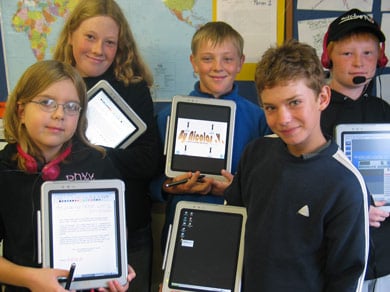
In schools, billions of dollars and more importantly, children's minds are at stake on when an how tablets will relate to  textbooks. With the promise of didactic games and easy monitoring of students activity, convincing academia is all too easy. Teachers agree, it makes and sense so why hasn't it happened yet?  Well, while there may be a huge potential future in filling schools with tablets, who exactly will stake a claim in this wide open territory is currently in serious contest. Doing it right is what really matters and real improvements don't usually happen the way we expect them to. Trying to get something as complex as a computer that is as intuitive and durable, in short, re-inventing the textbook, is not exactly child's play. In LA they've tried just throwing full size i-pads at kids with mixed results.(2)  Remember, we're dealing with kids, probably one the most un-predictable force in the universe.  In Bridge, the for-profit, mass-education enterprise in Africa, they use tablets in class in a different way, to give the curriculum solely to the teacher. Personally, I'm kind betting on Amplify as a major player in the US. They are probably most aggressively pursuing and trying to profit from tablets in schools though with no major success yet.(3) So yes, tablets may largely replace books in schools, but we can expect some failures and wasted government and corporate resources before someone gets it right. I'm sure though, with the right incentive and vision some very smart, motivated and focused people could get it done, but when those elements will combine nobody knows for certain. My own relationship with a tablet has come a long way, I started out neglectful but have since found myself using it on occasion, still its not anywhere close to books yet.
*http://en.wikipedia.org/wiki/File:Literacy_rate_world.svg
**Other episodes http://vimeo.com/11891919 , http://vimeo.com/11891958 , http://vimeo.com/11891958# ,
http://vimeo.com/11892454http://vimeo.com/11892516 also interesting http://darwinslibrary.com/
1) http://newsosaur.blogspot.com/2012/04/four-ways-newspapers-are-failing-at.html
2) http://www.latimes.com/business/hiltzik/la-fi-mh-ipad-adventure-20131120,0,942881.story#axzz2n3JmPH8H http://www.macworld.com/article/2065460/ipads-in-schools-the-right-way-to-do-it.html http://www.npr.org/blogs/alltechconsidered/2013/10/25/240731070/a-schools-ipad-initiative-brings-optimism-and-skepticism
3) http://mashable.com/2013/08/29/news-corp-education-tablets/
http://www.geekwire.com/2013/tech-tablets-schools-mix/
http://slashdot.org/story/13/10/08/1952215/nc-school-district-recalls-its-amplify-tablets-after-10-break-in-under-a-month
4)http://www.latimes.com/books/jacketcopy/la-et-jc-nations-first-bookless-public-library-system-opens-20140107,0,7098801.story#axzz2pmce0gj5

Tuesday, December 10, 2013

Refracting Sunset

 
Refracting Sunset 
Acrylic
This one is more of concept art I guess. I was thinking of an image that explores the nature of light, not so much what it illuminates, but the light itself.  A continuous wave that bounces around until it gets absorbed or some of the wavelengths are absorbed  producing color and shade by shade eventually darkening. This is what turned out. Kind of looks like a cubist sunset, a stain-glass or  as Ross says "diamond sunset." It'll probably end up on the wall at Sun Terrace.  I might at some point to do another variation maybe using neon colors or making it more symmetrical or using a computer.

Wednesday, December 4, 2013

The Thoughtful Investor- The Intelligent Investor for the Modern Mind

Seth Klarman
  Benjamin Graham's modern equivalent is this guy: Seth Klarman. Some may think that Warren Buffet is living out Graham's principles, but more than anyone Klarman really mirrors Graham's thinking.* Like Graham, Klarman grew up Jewish and on the East Coast. They both did well in school and had plenty of opportunities in academia but decided to take to money management instead. Like Graham, Klarman's greatest claim to fame was a book he published: Margin of Safety- Risk Averse Strategies for the Thoughtful Investor bleck! what an unappealing mouthful of a name! I'll just call it the Thoughtful Investor.
     The weird thing about the Thoughtful Investor is that the book itself is kind of an object lesson in investing. If you look on Amazon right now its selling for about $2000 used! As happens with many stocks this thing is way over-valued and if you are a real value investor you wouldn't think of paying that much for a silly book. I think this also is telling of the kind of ridiculous thinking that goes on among the types of people have their head in finance.  People in these circles produce the outrageous thinking that paying that kind of money for something so simple could actually be worth it! If you want to read the book and are a normal human being that doesn't throw around $2000, just look for it online, there are PDF's of the text floating around out there or e-mail me and I'll send you a copy.
        So what does Klarman talk about that is so valuable? Really, its mostly a modern, version of The Intelligent Investor. The language is more polished, and the approaches are more up to date, but the principles are much the same.  Where Graham used Price/ Earning, Book Value and Dividends, Klarman uses Net Present Value, Liquidation Value and Stock market Value to gauge price. He defines Net Present Value as the discounted value of all future free cash flows a business is expected to generate. Klarman also mentions private market value as a rule of thumb which I completely agree with, to give an idea of a businesses value when the market's going nuts. One useful resource I've found for private company info http://www.privco.com/  Klarman also brought to my attention spin-offs as a re-occurring source of investing opportunities.
     Even though Klarman isn't as original as Graham, he makes some great points and brings a modern intellect to Grahams principles. He has greatly added to the value investing cannon by writing and  practicing value investing and is definitely a heavy hitter in the world of finance.

Klarman's Fund https://www.baupost.com/


*One difference I see between Buffet and Klarman is their holding time. Klarman thinks its necessary to "continually compare their current holdings in order to ensure they own only the most undervalued opportunities available." Buffet says "When we own portions of outstanding businesses with outstanding managements, our favorite holding period is forever." I think Buffet is a less likely to sell just because he sees something better out there, while Klarman might try a little too hard to demand the best bargain as did Graham.
     Klarman also says: "Few value investors own technology companies, banks or insurance companies because they have un-analyzable assets and liabilities." If he sticks to this, it would be a huge difference between him and Buffet, Buffet obviously has no problem investing in banks like Wells Fargo and his first and most successful investments were GEICO and Illinois National Bank and Trust.  
     And finally, Klarman also demands hard assets to provide safety while Buffet is more comfortable with a strong moat whether its tangible or not.

Other quotes that I found interesting, useful or just plain liked in his book:

 "Value, like beauty is often in the eye of the beholder."

Once you adopt a value-investment strategy, any other investment behavior starts to seem like gambling.

Some people act responsibly and deliberately most of the time but go berserk when investing money. It may take months or years of work and discipline to earn the money and only a few minutes to invest it. Some spend more time buying a stereo or camera than buying stocks. Many regard the stock market as a way to make money without working rather than a way to invest capital in order to earn a decent return.

Greedy short-term-oriented investors may lose sight of a sound mathematical reason for avoiding loss. It is very difficult to recover from even on large, loss, which could literally destroy all at once the beneficial effects of many years of investment success.  

Downfalls For Institutional Investors: Size, Self Imposed Constraints and Willful Ignorance of Fundamental Analysis.


I believe indexing will turn out to be just another Wall Street fad. (REALLY??!!)


Above all, investors must avoid swinging at bad pitches.


If the prevailing stock price is not warranted by the underlying value, it will eventually fall.


Value investors are not super sophisticated analytical wizards who create and apply intricate computer models to find attractive opportunities or assess underlying value. The hard part is discipline to avoid the many unattractive pitches, patience to wait for the right pitch and judgment to know when to swing.


There are only a few things investors can do about risk: diversify adequately, hedge when appropriate and invest with a margin of safety.


Many investors insist on affixing exact values to their investments, seeking precision in an imprecise world, but business value cannot be precisely determined.

How do value investors deal with the analytical necessity to predict the unpredictable? The only answer is conservatism.

 Investors relying on conservative historical standards of valuation in determining private-market value will benefit from a true margin of safety, while others’ margin of safety blows with the financial winds.

Like Einstein’s theory of relativity this (Soros's theory of reflexivity) may slightly affect calculations but only in rare or extreme circumstances, and for the most part fundamental analysis is still on largely right.


Spinoffs seem to frequently be undervalued and large emerging industries seem to be frequently overvalued like railroad companies were, air freight was, computer companies were.
...it is important to remember that numbers are not an end in themselves. Rather they are a means to understand what is really happening in a company.

Good investment ideas are rare and valuable things, which must be ferreted out assiduously.

Value investing by its very nature is contrarian. Value investing exists where the herd is selling, unaware or ignoring.

Information generally follows the 80/20 rule: the first 80 percent of the available information is gathered in the first 20 percent of the time spent. 

No one understands a business and its prospects better than the management.

Arbitrage is a riskless transaction that generates profits from temporary pricing inefficiencies between markets.

Although trading based on inside information is illegal, the term has never been clearly defined.

And my very favorite! "Value, like beauty is often in the eye of the beholder."

Tuesday, November 26, 2013

Virtual Reality Check

If I had to take a guess what will be one of the most popular new consumer devices in 2014 ( the next i-phone) my pick would be the Oculus Rift. The Oculus Rift is a virtual reality head-set originally designed for video games. Yes, there have been a lot of attempts at Virtual Reality in the past and no one knows this better than the guy who designed this one, Palmer Luckey. Over a few years he collected about 56 different Virtual Reality Head sets including one that cost $97,000 which he nabbed for $80. He began taking them apart and tinkering with them in his parents garage. Out of that creative process emerged the prototype for what is now known as the Oculus Rift. But just getting the prototype built is one thing but having financial backing to see it built and do it at an affordable cost is very different. That's where Kickstarter.com has helped. Through the use of this "crowd-sourcing" website he raised $2.5 million and gained some momentum in actually bringing the device to the people who could design games for it. He has since recruited a big name in the gaming industry John Carmack among others. 

             The real reason that I think this could take off though, is not the $16 million that this small start-up has now amassed or the demand for the  next cool new gadget. What really intrigues me here is the guy behind product, Palmer Luckey himself. I mean if all I knew was his name, I would guess things will go well for him. But this kid was in community college at 14 and has spent time working fixing and selling cell phones and cleaning boats. He used money he earned to buy his Virtual Reality sets, originally just for his own video gaming pleasure. Upon the realization that there was no better device out there, he took matters into his own hands and been on a mission ever since. According to Wikipedia he was enrolled at the University of Southern California Institute for Creative Technology before transforming into the leader of the group now called Oculus VR. He seems to be passionate about and completely comfortable with hardware engineering and at the same time a non-stop promoter and recruiter. It looks like he has all the elements of a good old fashioned home grown American entrepreneurship, with the right balance of technical thinking and people pleasing.

The device, if it can deliver for $150, it will do something  that the U.S. government has spent millions of dollars trying and failing to develop. It could be used for anything from training to gaming to movies and has the distinct traits of disruptive innovation at work. If nothing else it has been a very inspiring story so far, but barring any unexpected mishaps, I see this going a long way. And I hope it does! This is the type of phenomena drives our economy it creates new industries and probably most importantly sparks your imagination.    


...If not, there will always be someone who will play it: Keith Apicary!