Thursday, April 2, 2015

Value Investing in Start-Ups

Summary:
What to look for in a start-up:
-A committed group (could Polyvore be an acquisition target for Pinterest?)
-A monopoly ( can Tesla find a monopoly? )
-Growth ( does Domo fit Benchmark's standard?)

Especially near Silicon Valley, it seems almost weekly start-up are making huge amounts of money going public or becoming Google's next acquisition.  It seems with that much upside it should be easy to make a major gain, just pick your favorite start-up, get in and wait for them to make it big? Well things might not be quite that easy as a quick sampling of the start-ups or number of applicants to start up incubators or Y Combinator will show. There are nearly infinite start-up ideas and almost as many dollars willing to bet on them, so is there a way to know which one will succeed and perhaps more importantly which will be most profitable?

Pierre Omidyar Left with Robert Kagle right
doanhnhansaigon.vn/khoi-nghiep/ebay-cua-pierre-omidyar/1039849
/
Venture capitalists devote their lives to spotting potential in start-ups and Robert Kagle who holds the record for the most successful venture investment ever is quick to warn that venture capital is an extremely high risk business. "In venture capital you lose all of your money over half of the time. In fact 10% of your investments deliver 90% of your returns." He goes on, "failure is the norm in venture capital, if you're not striking out you're not swinging for the fences." For Kagle and other venture capitalists, a healthy recognition of failure is a good idea so that when company looks like its going down they aren't freaking out about the lost investment. Accepting possible failure has allowed Kagle to get on early with Twitter, Uber, Snapchat, Instagram among others but it is probably his treatment of entrepreneurs has been more important. Before him entrepreneurs were considered employees to the investor, but he recognized Venture Capitalist's role not as one of superiority, but as "a privilege to invest in someone else's dreams." "We would be the stage hands and they would be the stars." he says.

Still, Kagle never claimed be able to consistently identify start-up successes, he knew the risks and took a swing, which kind of flies in the face of Warren Buffet's timeless wisdom that "You don’t need to swing for the fences in order to achieve satisfactory investment returns...”  But Buffet also says "risk comes from not knowing what you're doing." Implying that if you know enough of what you're doing you can avoid the risk, so you have to wonder, can anyone know enough to consistently recognize and invest in start-up successes? Building on Kagle's fundamental approach, I would argue one of his partners has done just that.

Peter Fenton at Benchmark Capital TechCrunch.com/ Flickr Creative Commons
Peter Fenton was likely drawn towards Kagle's team because of his history of seeing his dad's negative experiences dealing with Venture Capitalists, who to his young mind were like monsters, out of touch with the realities of running a business, abstract, with a false sense of their ability to predict the future. In his undergrad at Stanford and learning from his own experience Peter already had come to similar conclusions "If you can be in service to extraordinary people who are changing the world for the better, that’s a noble calling." Later after Kagle managed to bring Fenton onto his team, Fenton further refined Kagle's approach and avoided some of  his mentor's lost investments. He has gone on to be one of the most consistent, professional, successful, recognized, and awarded venture capitalists alive setting a high mark for others to follow.

How does he does it?  Although many would like to chalk Fenton's and others like Peter Thiel's ( who is a little more vocal and accesible that Fenton) success up to luck, their succesful exits seems to indicate otherwise. Calling their innate mental abilities, upbringing and graduate programs at Stanford luck is a different discussion, but as far as their ability to repeat their performance and make consistent investment in high growth start-ups, as Thiel says, attributing their results to luck is just an excuse for not thinking. And while their background no doubt plays a big part in their success, even for those who don't have their opportunities, there are still a number of basic lessons that all investors can apply.

https://www.etsy.com/market/wedding_silhouette
The first and foremost of these is long term commitment. Peter Fenton is a triathlete and that attitude of endurance is similar to his approach to business. Polyvore is a good example, Fenton has stuck with Polyvore through an initial change of CEO, slow growth over an 8 year period a major recent pivot as Pinterest has gained some major traction Polyvore seems to be finally picking up along with Pinterest and making it a possible acquisition target for Pinterest. Even with companies that have gone public, Fenton continues to sit on their board looking out for the long term welfare of the companies he's invested in. Although there might seemingly be a lot of differences between venture capital and more established business, long term commitment is a theme that is consistent throughout.  It is applicable in start-ups and established public companies.  As Buffet says,"you should invest like Catholics marry: for life." When you plan on investing long term you think more deeply about what you are investing in. As Peter Thiel likes to ask, has the team been working together for awhile and are they going to give up at the first sign of trouble? Will they enjoy working together or are they just sticking it out for work's sake?  Long term relationships between great people are both emotionally and in business is a lasting source of wealth.

musk scratching head
Elon Musk and the First Tesla
http://www.businessinsider.com/tesla-co-founder-sues-elon-musk-2009-6
Monopoly-Genuinely useful, original and new ideas are interesting, beautiful and rare and when effectively made reality are one the most valuable phenomena on the planet. For Warren Buffet, he's happy with just one a year. Such ideas tend to be closely tied to their owners life experience and be protected like a child. To discover them you often have to go where others are uncomfortable going. This is another way in which traditional value investors are actually similar to VC's. They both must look from a contrarian point of view because when everyone is thinking about it, it is likely over-valued. Where traditional value investors find value in macro fears or over-reaction to bad news, venture capitalists tend to find it in novelty and being technologically advanced.  As one of the central ideas in Peter Thiels book Zero to One suggests a successful company really needs a monopoly because competition in fact kills business. This can be a problem where new ideas are seemingly obvious applications of current technology which can then be duplicated.  At the time of Elon Musk's first Tesla, it was effectively a monopoly but as companies like BMW, Audi, Chevy, Toyota Musk will have to remain committed to keep Tesla afloat.
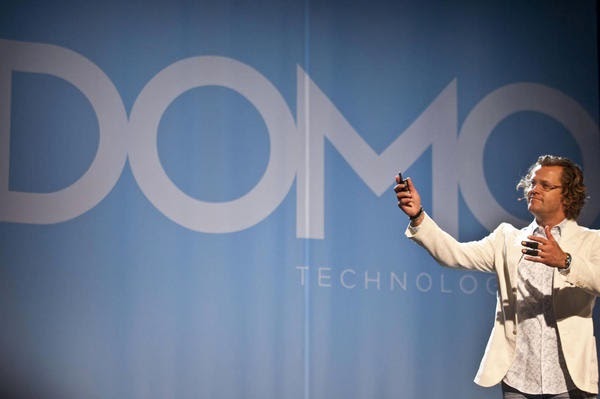
Josh James Domo
http://www.deseretnews.com/article/865575453/
Growth-The widely recognized number one reason that start-ups fail is that they are building something people don't actually want. As Benjamin Graham observed, "obvious prospects in a business do not translate into obvious profits for investors."  Benchmark handles this by focusing on  products that delight the user and  favoring open source and consumer market. This has been essential to their success because the business to customer (B2C) market will always have more growth potential than business to business (B2B). Sometimes in looking for growth, investors want to see revenue, but as with value investing getting caught up in the immediate returns isn't as important user growth. In a sense it is odd than that Benchmark funded Domo as it seems to diverge from these characteristics. DOMO is sales driven over product driven as their CEO openly states: sales is number one. Also, Domo is focused solely on products for CEO's which is not at all consumer market. But even though Domo is well outside of Benchmark's usual sweet spot, as with Tesla, as long as they have the eccentric CEO Josh James, he'll find a way to make it work.

Obviously this is not the longest list start up rules but a place to start when weeding out potentials either as investments or job opportunities. As the examples show, it is nearly impossible to come up with absolute rules because the genius, renegade CEO will always break them. But since Silicon Valley seems to only become more and more relevant as technology progresses, understanding how to find value in the world of tech start-ups seems to be worth the effort.

Benchmark group interview forbes-https://www.youtube.com/watch?v=b_nChmdMOgs

https://www.youtube.com/watch?v=ipmfg-A1LQw    How do we find new companies?


Saturday, December 20, 2014

Evaluating the Paypal Spinoff

  • Paypal holds more growth potential than marketplace side of E-bay  
  • Paypal could see major growth if it gets access to upward trends in mobile payments and other emerging markets 
  • Paypal will be challenged by Apple Pay and Google Wallet in mobile and other regulatory and legal barriers
  • Paypal should be fairly valuated at around $40-45 billion when it spins off  

     As I've suggested in another article technology has systematically disrupted information based industries and potentially the next industry that's in line is the more entrenched world of finance. One company that is uniquely poised in that disruption is Paypal. According to Paypal's next CEO Dan Schulman "There is no question that change is going to sweep through the financial industry. The financial industry is no different from other industries where technology has touched down."

Background: In late 1998 at Stanford, Peter Thiel introduced the idea of a digital wallet to Max Levchin and Luke Nosek. The three began working on the concept which later turned into the company they founded Confinity.  That service (after a brief stint with Elon Musk as CEO) evolved into PayPal in 1999 and was acquired by E-bay back in 2002. Although integrated with E-bay at this point it was still an unsustainable jumble of ideas kept alive by future Silicon Valley influentials. Its payment volumes mostly came from the E-Bay which made it a natural acquisition target for the E-bay. Paypal survived mainly because most of E-bay users were individuals or small businesses that were unable to accept credit cards. After struggling to find place within E-bay's growing user-base, in the second half of 2004, PayPal Merchant Services began to enroll other online merchants outside eBay as well as reducing fees for online purchases and launching PayPal mobile.

     Since then Paypal's contribution to E-bay's earnings has continued to outpace the growth of its parent company and E-bay may have even slowed Paypal's ability to expand its reach, specifically in hindering the launch of PayPal App. Along the Paypal has been able to acquire other related startups like Braintree, Venmo, card.io, fig, bill safe, and Bill me Later that have roughly fit into its lofty although vague mission statement being the "Web’s most convenient, secure, cost-effective payment solution," in some cases doing it better than Paypal itself.  Still after the spin off, will Paypal still thrive without Ebay's backing? At this point Paypal seems to have more potential and more opportunity for growth than its parent and with its spin-off coming in early 2015 it's worth taking a look where its potential lies, what lurking obstacles might hinder that potential and what a good price for the company would be when it does break away.

Forecast US Mobile Payments
http://www.businessinsider.com/the-mobile-payments-industry-update-2014-10
Upside-The biggest immediate challenge and opportunity for PayPal is racing against tech giants like Google and Apple in the sphere of mobile in store payments. Mobile payments alone are predicted to have a 90 billion market by 2017.  Along with these grandiose tech companies, major credit card companies will also vying for this space. Paypal has already preemptively produced an app although it has still fallen short of anything that is as efficient and easy to use as traditional credit cards. Google wallet and Apple pay have the huge advantages in this area because they are backed by large established databases and services customers already trust. At the same time the size and scope that these companies work under could slow down their ability and motivation to profit from this area of tranformative growth.

In Paypal's favor, its future CEO Dan Schulman seems to be suited almost specifically for this task. His experience came from telecom starting out as an AT&T executive then in 2001 growing Virgin mobile USA to be acquired by Sprint in 2009. Most recently he has been trying to expand the reach of American Express to people without access to traditional banking by using digital alternatives like mobile. While in this endeavor, he caught the vision of a tech driven sea change in how banking can be done.  Driven by a desire to give banking access to under-served populations, and undo the convention that "its expensive to be poor" he says: "I believe that we are entering into the era of the non bank. An era where consumers have all the power of a bank branch in the palm of their hand. Its not hard to imagine that technology is going to redefine the world of consumer retail banking.  Digital wallets are morphing into tools that can serve as a real alternative to bank branches." And while I don't think we will see traditional banks disappear altogether I do think he is on the right track for growth and how to reach youth and lower income segments.  It also suggests that Schulman will do whatever is necessary to cut costs to the user while working to make the Paypal app more intuitive user-friendly. I also think he may also try to make other relevant banking services accessible to Paypal users through the Paypal app. While he has the right direction and motivation I could see him struggling to adapt to a more startup, innovative minded environment and pulling together the right team and working to get the technology right as his background is more from an executive and finance mindset.

In addition to a CEO who will pursue his vision of bank alternatives, Paypal has already established agreements with retailers that it will could try to expand into in store purchases. Most likely Apple, Google and Paypal grow with this trend with Paypal getting the most movement if it is able to make a compelling app and partner effectively with banks or credit card companies in the process.
 
   In addition to replacing credit cards there is also a  growing market of peer to peer digital payments, Mobile peer to peer and Paypal at this point is by far the most recognized and trusted service positioned for growth in this field.  Along with direct peer to peer payments using Venmo, growth could come in this segment as services like Uber, Lyft, AirBNB, and other mobile transactions rely on its service to make their businesses work.
PayPal Here Vs. Square
http://www.cardfellow.com/blog/paypal-here-vs-square/
     In a related application Square has enabled transactions for small business and opened up a new market which can work with Paypal and which  Paypal has countered with its own mobile transaction device to compete with square.
As other small businesses and store fronts convert to using a computer checkout they often favor this convenient device for credit card transactions. Although insert will  become obsolete with implementation of mobile payments, it will likely continue to fill a necessary niche for a long while before payments go completely to smart phones.

Risks-Some obstacles that Paypal will continue to face are similar to ones that it has faced since it began:
-Continuing to gain the trust willingness of customers to use Paypal without direct support from E-bay
- Still being unproven method of handling money and continuing to get access to more retailers and users to give it a chance despite many drawbacks
-Pressure from Visa and Mastercard older, established systems that have huge experience and databases that are not going to give up their position willingly. For Paypal to compete with the credit card system they would need instant transactions rather than waiting for days for orders to process as they currently do with E-Bay
- Paypal has many of the safety issues of a bank, hackers and fraud that have used its open nature to take advantage of Paypal users. As Paypal grows it will continue to have to deal with regulation and how to interface with purchases in other countries etc.
    Along these lines my own experience has been that when selling larger priced items on E-bay there are offers from scammers in questionable locations like Nigeria offering to buy the item. I can only guess, but I imagine once they see the item being shipped they cancel the payment and take advantage of the time lapse in payment to take the merchandise and run. Luckily I'm not naive enough to send a $500 camera to Nigeria but this is just one anecdotal sample of likely countless other instances where users have hacked accounts and found other fraud angles to take advantage of the weaknesses in this new type of transaction. As with many types of new technology and the sharing economy, it assumes a certain level of intelligence and self reliance in its customers which is wonderful but only works if people actually live up to these ideals. If customers act like users in the old banking system and care more about fraud than getting things done better the system will not move forward.

Conclusion- While about a third of Paypal's payment volume still comes from E-Bay, there seems to be little doubt that the more profitable of the two companies will ultimately be PayPal. Current E-bay CEO John Donahoe has indicated that "While eBay’s marketplace, the company’s core business, accounts for over 30% of PayPal’s annual revenues, that figure will dwindle to just 15% within three years. And while the Ebay's $9.9 billion in revenues last year eclipsed PayPal’s $7.2 billion, PayPal’s 19% annual revenue growth outpaced Marketplaces’ 10%."  As seen in the chart below Paypal has grown consistently along with E-Bay since 2002 and went from making up 18% of its revenue to 38% in 2011.

http://vator.tv/news/2012-07-08-now-10-years-after-being-acquired-paypal-going-strong 
         So there's a lot of  room to grow and a lot of potential, but what it actually worth? Both E-bay and Paypal have about 150 Million users. In E-bay's 2012 Revenues was about $16 Billion in 2013 and  probably around $19 Billion in 2014. As Donahoe points out 40% of that is coming from Paypal so simply taking 40% of E-bay's current would give a rough valuation of  $40-45 Billion not factoring in Paypal's more optimistic future. For me anything below $40 Billion divided by the proposed number of shares would be enough margin of safety to get a stake in Paypal growth. The growth will likely be a very bumpy ride but if you stick it out, there will quite possibly be solid upside that will continue to compound as it plays an integral part in financial transactions for a long time to come.

Friday, December 5, 2014

Bhutan House

A quick colored pencil of some traditional Buthan architecture I have been looking at lately. I like the low, slightly sloping, horizontal lines and wide intricately decorated roofs that flow seamlessly into the landscape. Their landscape actually reminds me a little of the hills of Northern California (maybe that's just me) but I feel like the style would be fitting for the Asian influence there. It does slightly remind me of some architecture is Berkeley but apparently University of Texas El Paso campus has a heavy Bhutanese influence.  

Thursday, October 30, 2014

A Grocer's approach to health insurance- Rewarding health with wealth

Grocery Bag With Fruits and VegetablesIf you work for Whole Foods or Safeway, staying healthy is more than just good advice, it also means better benefits. As of 2010 John Mackey the CEO of Whole Foods released a letter that proposed an interesting new method to giving employees discounts. As seen below, this letter offers employees a better discount as they perform better on tests of smoking, cholesterol and BMI. John Mackey has the right idea as there may be few other individuals who can better combine a better understanding of health and free market enterprise for the benefit of the general populace and really, if you're thinking about working at Whole Foods you should expect something like this. Along with the discounts, Whole Foods offers a custom insurance plan for its team members as well as a total health immersion for members that are especially sick or struggling with weight. While for most team members the discount they can receive may not have much impact on them financially its is a small start and may be just enough incentive to nudge them in the right direction.
http://lol-rofl.com/treadmill-cartoon/

This attitude that Whole Foods is presenting seems not to be that far ahead of  other organizations to encouraging workers and citizens to take their health and finances into their own hands.  The former CEO of Safeway Steve Burd, was an early adopter of financial incentives to help employees cut tobacco use and reduce blood pressure and cholesterol levels. Burd has said that obesity and smoking rates among employees in the voluntary program are roughly 70 percent of the national average. Like their employees' bellies, Burd testified before congress that his company’s health care costs have been flat “while most American companies’ costs have increased 38 percent over the same four years.” This topic of how much employers can encourage their workers to stay healthy is one that has been debated and addressed initially by the US government under HIPAA and then expanded through Obamacare.

Currently companies like Scott's Miracle Grow, IBM and even the state of Alabama are thinking along the same lines and have already applied policies that will reward healthy living. Along with state and businesses adoption of health promoting incentives, health insurance companies and hospital groups are beginning to adopt programs with similar incentives. So these wellness programs designed to motivate workers to adopt healthy lifestyles aren't going away, and if anything are part of a trend that will likely continue to grow.

The bulk of the US's health care costs come from preventable diseases. Obviously these incentives wont completely change attitudes or the world, but could be enough to give an extra push to people that just need an excuse to eat right or do things better. Of course there are a lot of genetic and otherwise currently un-treatable diseases, but the since its the preventable ones that are hurting us the most they are a good place to start. One objection against this incentive based approach brought up by AARP is that if you give one person a reward that someone else will end up having to pay for it. This shortsighted thinking fails to see that any immediate cost difference will soon be outweighed by the benefits as long term costs are severely reduced because the program is based on preventative steps shown conclusively to prevent disease. Giving people incentives to stay healthy is an obvious application of an ounce of prevention to avoid having to pay for a pound of expensive cure.


http://www.brit.co/stars-stripes-in-fruit-form/
In reality one of the greatest downsides to this approach may to those who are not working and continually punished by a system that only rewards people that only share its attitude. This could cause people who are already struggling in other areas of their life along with their health not be able to find employment. So then, the challenge is to keep it a positive non-exclusive incentive. Rather than punishing or excluding people through hiring, companies would need to design incentives that will take current workers and subtly encourage any step they take to pursue better health as Whole Foods does. Another potential downside I see is where government or companies use this as an excuse to intrude on people's personal lives. Tests about depression and other more personal matters may not be desired, but I think as long the the checks are moderate and left to the private sector this could be a very helpful tool to urge the working American public in the right direction. It will work best for those who just need a small excuse to change things. As people actually change their habits they create less costs because in theory, the illness will be prevented. As long based on clearly demonstrated data everyone can potentially benefit from incentives that motivate people to take better care of their health.

http://jezebel.com/5456561/weigh-less-pay-less-whole-foods-offers-discount-based-on-bmi


Americans Support Health Insurance Discounts for Healthy Lifestyles
http://www.rasmussenreports.com/public_content/lifestyle/general_lifestyle/may_2012/americans_support_health_insurance_discounts_for_healthy_lifestyles

http://newsroom.intel.com/community/news/blog/2012/5/16
Future Food Service-John Dickman

Tuesday, September 30, 2014

7 Reasons to Like Wes Anderson

Wes Anderson's movies are the indie music of film. Like the folk, indie music, Anderson will never be on the same level mass distributed franchise media because he doesn't excel with hi-tech, digital, special effects laden, eye-catching work. He will stay in a hallowed realm in the entertainment industry; as he consistently produces films and also draws in an increasingly interesting troupe of actors. Unlike high-budget digital films, if you are not tuned in to the subtleties that make his films appealing, you might call them dry, slow or pretentious. Still, I think there's a level on which most people are entertained by Anderson's work because despite their niche appeal, they are still very successful at conveying stories that capture human quirks and idiosyncrasies in a humorous (and highly-stylized way). My feeling is that he will continue to make films and although they may not be as fiercely original what the ones he first wrote Owen Wilson, he will further explore his storytelling ability and artistry further.

1.The Kids of Rushmore  To get to get to know where Wes Anderson comes from you don't have to go much further than his second film, Rushmore. Like the protagonist played by Jason Schwartzman, Anderson attended a private school (St. Johns in Houston, TX) when he was young. He projects himself onto Schwartzman's character, whose picture might be found in the dictionary under "precocious." He is a natural organizer and leader, and is in his element as he confidently strides around looking over his busy productions and discussing the details of some loose end. Underneath Max's accomplished exterior (and similar to Anderson's own school years), there is rebellious adolescence, dissatisfaction with his own father and contempt for other authority figures.  This growing conflict eventually climaxes and Max is defeated and crushed, giving up all pretense of greatness. As Schwartzman's character accepts his dad's own humble circumstances, I think Anderson also expresses (through this film) acceptance of his own background with its shortcomings and humble situation. This is one of his better films because rather than a soul-less upper class searching for meaning, it shows a dissatisfied middle-class striving for recognition, and learning self-respect among-privileged peers. I enjoy films where we see the development and growth of Anderson through his characters. I love the conflict, competition and hilarious pranks that the struggle produces.  As Anderson projects himself onto the young protagonist, it shows another theme repeated in his films of respect and recognition of children as worthy peers.

http://www.architecturaldigest.com/blogs/daily/2013/11/
2. Lasting friendships When asked what the defining characteristic of his fans is Anderson said that his films appeal to outsiders. Individuals that don't belong find identify with Anderson's films. It might sound cheesy, but friendship is a theme at the heart of Anderson's movies and it is a theme that has lent warmth and timelessness to Anderson's films and is true to Anderson's own experience. The idea for Rushmore was conceived by Owen Wilson and his college roommate in Austin, Texas as the two together plotted ways to get back at their landlord.  Like Owen Wilson's character in the Royal Tenenbaums, Anderson seems to fit in well with the Wilson family and included Owen's other brothers Luke and who are all present in both films and the main characters in his first film Bottle Rocket and Anderson has continued to remain friends with Owen to this day. So while Anderson continues to collaborate on films with many others, his most successful and memorable films were written teaming up with his old pal Owen.

3. Bill Murray and the Gang. The same goes true for the other members of Anderson's acting troupe. After he somehow managed to recruit Bill Murray and Schwartzman for Rushmore he has continued to develop these working friendships and has never felt a need to replace them for newer faces over the years even as he recruits more respected actors to his films. Along with Bill Murray, Anderson seems to recycle other sidelined actors like Jeff Goldblum and Adrien Brody that otherwise may have faded slightly  further into obscurity. They still have an appeal and juice, just not enough to dominate the limelight and Anderson, is more than willing to use his films as an excuse to continue hanging out with this amazing group. If nothing else Anderson's movies have become a fitting museum for Bill Murray's comedic legacy.
   
Many people are surprised when they see Royal Tenenbaums for the first time with its A-list actors like Ben Stiller, Gene Hackman, Gwyneth Paltrow, Bill Murray, Danny Glover and Alec Baldwin, but in this film more than any other Anderson demonstrated mastery at weaving so many unique personalities into a cohesive and entertaining story. Anderson is completely competent with high level actors, using  his classy, not confrontational approach yet still keeping a very clear vision of how he intends his movies to look . He allows actors to work without in a straightforward less demanding production. They might not gain any major attention, but they don't need it and are okay with the lower stress and easier pace of these more marginal films. This is Anderson's circle and in fact, at any point where Anderson has tried to edge into large productions with heavy action or special effects like the Life Aquatic or Fantastic Mr. Fox, it has ended in box office disappointment.

4.  Nostalgic Musical Selection
 Even in Anderson's least successful films, the music selection for are a masterpiece unto themselves but even more amazing is how he brings the music to life through the movies. For some of the songs its as if this was the music video they never had but needed. As with his actors, Anderson has a continuing working relationship with Mark Mothersbaugh who has contributed theme music and filler music for Bottle Rocket, Rushmore, The Royal Tenenbaums, the Life Aquatic, The Fantastic Mr. Fox and Moonrise Kingdom. The other most common songs and bands from the 70's resurrected through Anderson's signature slow motion or underwater shots. Bands like the Beatles with singles by Nick Drake and less heard tracks by Rolling Stones stones sprinkled with a collection of tastefully selected classical music. Even though Anderson's vacation to India excused by the productions of Darjeeling Limited (I would have preferred somewhere closer to home like central America) fell short with limited viewers and a hollow plot, his music selection showed through unforgettable.


5. Deliberate Dialogue. His dialogue makes little pretense at being natural or reflecting real life which actually makes it even more memorable.  Like many of the shots in his films, it is so obviously crafted that while it can't be mistaken for a casual conversation that same awkwardness gives it a human touch.  The characters are direct yet polite, not violating and social norms until the the situation has become so extreme that they are forced to. In some ways it reminds of the slow moving, hand crafted dialogue from classic films that expresses itself succinctly if not poetically. Anderson's phrases seep into one's memory and come out often and they could make for an meta type play. Clever comebacks are constant because the characters are quick-witted and the humor is woven into the events themselves. The characters are not trying to be funny and their humor comes out as an extension of their already developed personality. Along with the subtlety in the characters, anyone with an eye for detail will notice the shots are minutely managed and color and symmetry are closely calculated.  Along with the dialogue almost every shot in Anderson's films  are deliberate but I think the tightly written dialogue is something rarely seen anymore and what I enjoy most. 


The Royal Tenenbaums Family A Beginners Guide to Wes Anderson Movies6. Family. Movie themes of family failure and conflict and reconciliation are at the center of almost all his films along with character introspection and subsequent development. In particular The Royal Tenenbaums came out before Arrested Development or Modern Family but I would trace the cultural roots of both back to this, Anderson's finest film. Both Tenenbaums and Arrested Development include formerly successful families having to come to terms with what really holds them together after their fortune and fame have been stripped away. The more you compare the two, the more similarities can be drawn; one of the most obvious is that both include something resembling incest between two family members which is source of comedic material and drama.  In fact Arrested Development creator and head writer Mitchell Hurwitz said that when he saw The Royal Tenenbaums, he already had the idea for Arrested Development in mind and thought, “Well, I guess I won’t be doing that,” but subsequently changed his mind. Again, Children are also a consistent and prominent presence in Anderson films and they are presented in as real characters who demand respect, not mere tolerance. He does his best when working with intensely felt emotions buried under social conventions which makes for forced understated and awkward interactions. 

7. Low Budget. Overall watching Anderson's movies is like eating a meal that is full of organic eclectic ingredients, flavorful yet not overtly appealing. There is a methodical feeling to his films and unlike other mass produced movies that leave you feeling gross, lazy and overwhelmed at the end you feel more like you have been out with old friends in  the clean, calm, organized (though quirky) world of someone who thinks clearly and deliberately about what they're doing. Anderson may not do as well channeling huge amounts of  cash into higher budget action productions that will leave you reeling yet you will still laugh, wonder and be drawn in by unique characters and their struggles. I tend to think that Anderson will continue for many years ahead to make films and I would really like to seem him write another film with Owen Wilson. I think Wilson's foray into historical fiction like Night at the Museum and Midnight in Paris type would be a perfect fit for Anderson with just the right amount of fiction to take the audience beyond reality but not so much that its totally reliant on digital, high tech special effects and could bring Anderson further into mainstream. Either way Anderson will never have the raw violent emotional appeal that captivates the masses and for those of us who do appreciate him, we wouldn't want it any other way.


Sunday, August 10, 2014

Lazin' on the bay

I was interested in the reflecting light on the sea lions so I decided to paint a group of them. As usual the painting doesn't really do justice to the real thing, but its more about the process
.

Tuesday, July 29, 2014

Lending Club IPO- Transforming Lending


I submitted this article to seekingalpha.com

Summary: Lending club has had consistent growth in number of loans issued since 2009, and holds a competitive advantage over traditional lending institutions. While I don't generally recommend Initial Public Offerings, this company doesn't seem to be going public because they need money. 

Background:  What do Borders and Blockbuster have in common? They are both information based businesses that have been largely displaced by the internet. Looking back at the story of the US economy during the turn of the century I think we'll agree the dominant trend will be the internet disrupting large, information based products like these.

As Lending Club CEO states: "There have been many examples of this happening before, whether it was when Borders could not react fast enough to Amazon or when Blockbuster could not react fast enough to Netflix and eventually went bankrupt. There have also been many attempts at companies trying to survive by spinning out low-cost operations... Despite their best efforts they keep the same culture."
Renaud Leplanche

The financial industry could very well be the next one up for a ride.  Every interaction of the financial industry is currently being re-evaluated from transactions with Paypal, to fundraising using Kickstarter public funding with Neighborly and even currency itself using Bit-coin. While I'm not totally convinced that all these "innovations" will turn out to be real improvements, one in particular has caught my attention. Partly because Lending Club is going public, I've been thinking about Peer to Peer Lending. Peer to Peer Lending first emerged in the UK with Zopa followed by companies like Funding Circle and Assetz Capital.2 The essence of these peer to peer lending is that the companies are not issuing the loans but simply use the internet to facilitate loans being made from one person to their peer.
Peer to Peer Lending
https://www.prosper.com/welcome/how_it_works.aspx

Peer to peer lending is the natural development of applying the internet to finance. This is the emergence of an entire industry not limited to one or two companies. Along with peer to peer lending, micro-finance organizations for charity like Zidisha have popped up using the internet to give individuals access to funding otherwise un-available in  developing world. Out of this developing field two major players in the U.S. that have shown staying power are Prosper and Lending Club. In 2008 during the financial crisis, the SEC required these companies to register their loans as traded securities, and offer re-sale on a secondary market which ended up suspending new loans from being issued and forced Zopa out of the US market.2 After adjusting to the new regulations, both companies were able to resume issuing loans near the end of the financial crisis of 2008-2009 with Lending Club taking the lead as the largest, best run Peer to Peer Lender in the US.  Lending Club had originally been formed by Renaud Laplanche in 2007 partly "after he became irked by the massive disparity between the 18% interest rate on his credit card bill, and the 1% savings rate at his bank."Laplanche collaborated with Oracle co-worker Soulaiman  Htite in 2006 and initially tried to issue loans through Facebook but later realized they would have to build their own platform. Video summary: http://youtu.be/GWsVTu1rgUo

Potential- Since then Lending Club has continued to facilitate more loans, gain financial strength as well as recruit prominent financial industry leaders to their team. John Mack former CEO of Morgan Stanley and Lawrence Summers former chief economist at the World Bank, Simon Williams former Citigroup head of Global Consumer Risk are the more notable recruits.4


https://www.lendingclub.com/info/statistics.action

Probably the strongest indicator of their success though, is the continued increase in number of loans facilitated which more than doubled from $600 million in 2013 to $2 billion in 2014. In addition to this consistent upward trend as LePlanche states: "I feel that our competitive advantage compared to traditional banks is really long lasting because, again, it is grounded in technology and cost, not something they can react to. The amount of debt that American families are carrying is really huge, so the opportunity to make an impact and help people is really tremendous."1

2013 SEC Report http://tinyurl.com/n93dj9u  p.58


Risks- while Lending Club has enormous promise and is growing at an surprisingly consistent pace, it should still be remembered that this is a high risk start-up that has only 1 year of actual functioning with positive income. This is an industry that 10 years ago wasn't even an idea and it has never paid a dividend and is untried in its long term performance. With revenue of about $100 million and net income for the first time becoming positive around $7 million in 2013 this company has a long way to go before living up to the $1.55 billion dollar valuation heaped on it via the loans from $125 million investment by Google, $15 million from Kleiner Perkins and others. 7 For the long term investor it will likely take years and overcoming some large setbacks for Lending Club make money for  its investors. It is by no means a sure bet during the bull market in an economy artificially propped up by a federal stimulus.

Along with its profitability, Initial Public Offerings in general are not a great way to find value, as Warren Buffet has stated in different ways on multiple occasions: "It's almost a mathematical impossibility to imagine that, out of the thousands of things for sale on a given day, the most attractively priced is the one being sold by a knowledgeable seller (company insiders) to a less-knowledgeable buyer (investors)."8 His own history speaks even louder as he grew his wealth without ever having to purchase an IPO.  Or as Seth Klarman explains: "Gone are the days when a new issue was a collaborative effort in which a business that was long on prospects but short on capital could meet investors with capital in hand but few good outlets. Today the IPO is where hopes and dreams are capitalized at high multiples." 9  Or as Ben Graham, quips IPO really stands for Insiders Play Only, so for the true value investor IPO's are out of the question.


http://www.lendingmemo.com/lending-club-for-investors/
Despite the IPO drawbacks, I think that for every 100 or so overvalued new issues there may a few good ones hidden in the mix if you have the time, acumen and patience to identify them. And if we can take LePlanche at his word, Lending Club isn't actually going public because they need the cash but primarily " to use it as an opportunity to raise awareness for the company."1

Recap: Because Lending Club is run using the internet to its advantage, I believe it will continue to take market share away from banks, credit card companies and other traditional lenders by offering better rates to individual borrowers and lenders. Although Lending Club is a company organized around the internet and has a culture that will give them a competitive advantage, it is still an untried business model in an emerging industry. My personal interest in this company is not purely about making more money so much as participating in the greater cause of reducing people's personal debt and losing less money in unnecessary administrative and bureaucratic costs that have built up in older financial systems. I have used Lending Club's service as an investor for about 6 months and I think it holds the potential for a genuine improvement because it should enable  people to more quickly reduce personal debt and get above a 1% return on their savings.

Disclosure: I am an investor in loans using the Lending Club website. I will most likely invest a small amount of money in the IPO depending on the price.

1. http://www.lendingmemo.com/lending-club-renaud-laplanche-interview/
2. http://www.bizjournals.com/sanfrancisco/stories/2008/10/13/daily55.html
http://en.wikipedia.org/wiki/Peer-to-peer_lending.
3. http://www.forbes.com/sites/parmyolson/2013/05/02/google-buys-stake-in-lending-club-valuing-peer-to-peer-lender-at-1-6-billion/
4. https://www.lendingclub.com/public/board-of-directors.action
7. http://www.forbes.com/sites/parmyolson/2013/05/02/google-buys-stake-in-lending-club-valuing-peer-to-peer-lender-at-1-6-billion/
Margin of Safety Risk Averse Value Investing Strategies for the Thoughtful Investor Seth Klarman
9 http://www.cbsnews.com/news/buffett-ipos-are-almost-always-bad-investments/

"Neither do men put new wine into old bottles: else the bottles break, and the wine runneth out, and the bottles perish: but they put new wine into new bottles, and both are preserved." Mathew 9:17